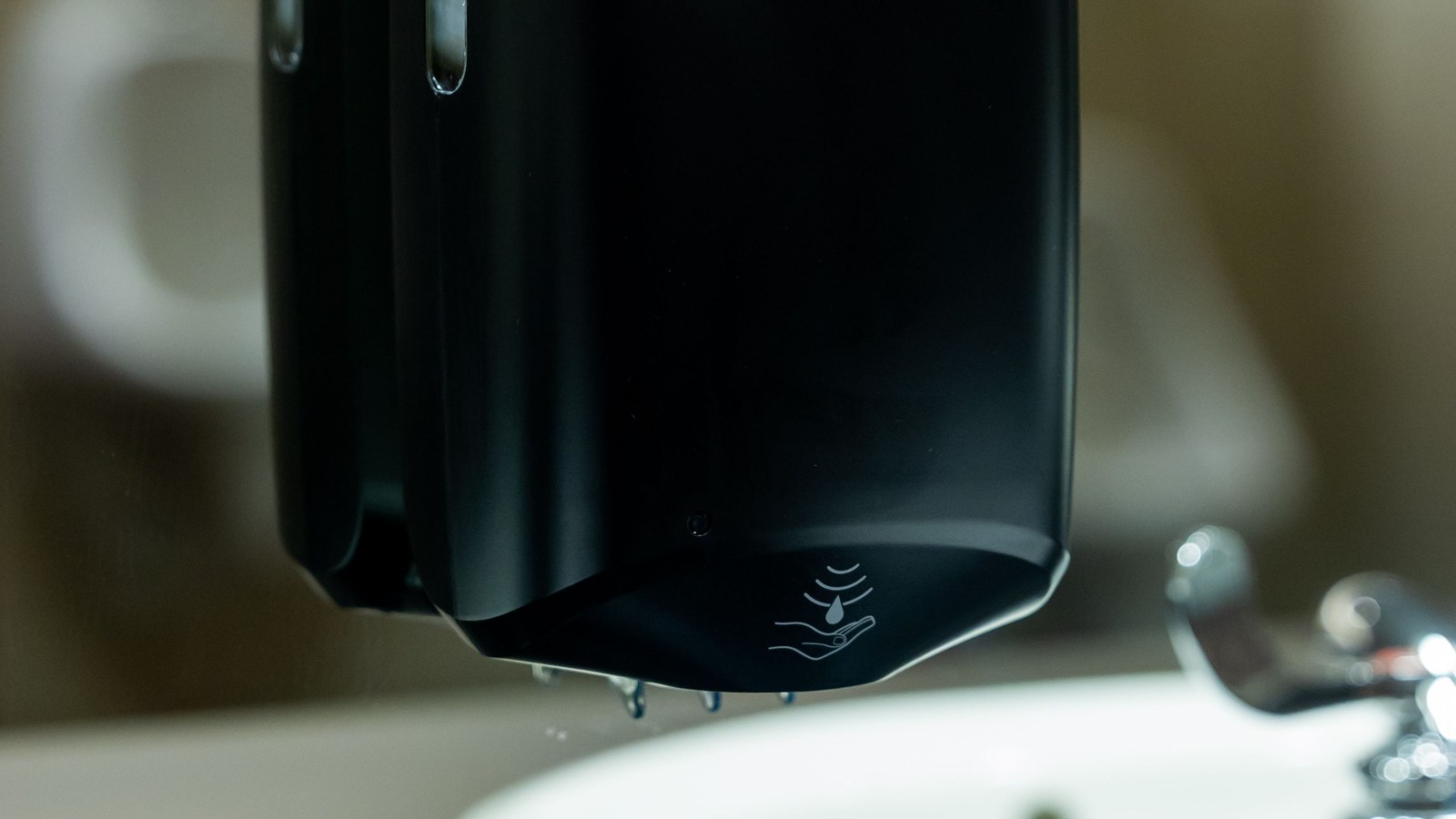
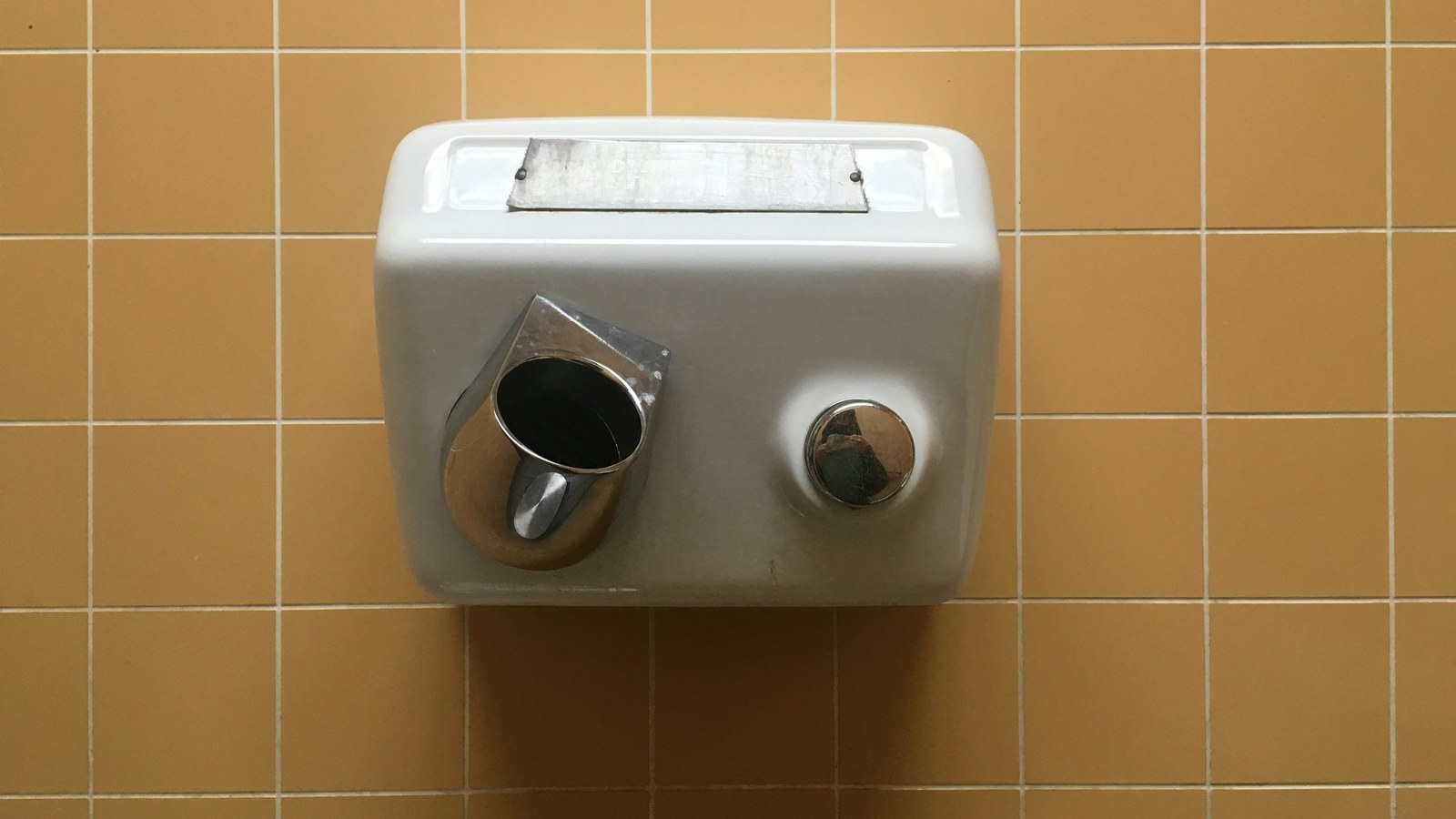
A bathroom hand dryer detects your hands, starts a motor-driven fan and directs air across wet skin to remove water. The differences you notice—warmth, noise, drying speed and responsiveness—come from the sensor, motor, air path and control settings working together.
On this page 13 sections
- What is a bathroom hand dryer?
- How the main hand-dryer technologies work
- How sensors make the dryer touchless
- How airflow removes water from hands
- Motors, noise and everyday comfort
- How to compare hand-dryer energy use
- Hygiene and filtration: what the technology can claim
- Common faults and safe maintenance
- Smart features: available functions versus possibilities
- Frequently Asked Questions
- Important Points / Key Information
- Examples / Supporting Information
- Conclusion
Part of our computer hardware technology guide library
What is a bathroom hand dryer?
A bathroom hand dryer is an electric appliance that moves air past wet hands. Some designs place the outlet above your hands; others have a drying space into which you insert them. The UK Energy Technology List describes the drying mechanism as physical displacement of water, evaporation, or a combination of both. [1]
Inside a sensor-operated dryer, a controller connects hand detection to the motor and fan. An air inlet, duct and outlet shape the flow. Depending on the model, the unit may also contain a heater, a filter and protective controls. There is no single internal design shared by every dryer.
The useful question is not simply whether a machine is “modern”. It is whether its design dries hands fully, responds reliably and suits the space where people use it.
How the main hand-dryer technologies work
The sensor detects hands in the drying zone
A reflected-infrared sensor uses an emitter and a detector. Light travels toward an object, and some returns to the detector after reflection. Vishay's presence-sensor application note explains that the returned signal depends on the object's surface and shape as well as its distance. Ambient lighting can also affect sensing. This is a general mechanism, not a universal detection range for hand dryers. [2]
Some designs use distance-sensing technology rather than relying only on returned-light strength. Dyson's India Airblade 9kJ specification, for example, lists time-of-flight activation. That is a documented feature of that model, not proof that every touchless dryer uses the same sensor. [3]
For more engineering explainers, explore our hardware topic hub .
The motor turns a fan
The motor supplies rotation; the fan moves air through the machine. Motor design, the fan, the resistance of the air path and the outlet geometry all matter. A high motor-speed number on its own does not tell you how comfortable or effective the dryer will be.
High-speed dryers are not all brushless. Dyson's Airblade 9kJ sheet lists a digital brushless motor, whereas Mitsubishi Electric's Jet Towel Smart JT-S2AP page lists a commutator motor. Both are manufacturer-documented examples of different approaches to jet drying. [3] [4]
The outlet directs the airflow
The outlet determines where the air meets your hands. A narrow slot can create a concentrated jet, while a wider opening spreads the airflow differently. Mitsubishi Electric describes a wide nozzle and changes to its wave-nozzle design intended to reduce turbulence noise. Those are design features, not guarantees that every user will find the unit quiet. [4]
A drying-time figure is meaningful only alongside its test conditions. Hand position, the chosen mode and the definition of “dry” affect how a reported figure should be interpreted.
Heating and electronics control the cycle
A heater can warm the air, but it is not essential to every drying system. Dyson's India specification lists no heater. Mitsubishi Electric's JT-S2AP has heater-on and heater-off settings. Cool airflow therefore does not automatically mean a heater has failed. [3] [4]
The controller starts the motor after detection and stops it when the drying zone clears, according to the model's timing logic. Products can also have protective limits and lockouts. These are appliance-specific controls: settings or thresholds copied from another model should not be treated as service instructions.
How sensors make the dryer touchless
Touchless operation removes the need to press a shared start button. It does not wash hands or check whether washing was effective.
The simple control sequence is: detect hands, confirm the input, run the blower, then stop after hands leave. A brief run-on may be part of the design. For eligible products, the UK Energy Technology List limits that run-on to two seconds; this is a scheme criterion, not the specification of every installed dryer. [1]
A sensor window needs a clear view of its intended zone. A nearby obstruction or a dirty window can affect detection, but unreliable operation is not enough to identify the faulty part. Persistent problems need the correct manual and qualified service rather than an assumed sensor replacement.
How airflow removes water from hands
Fast air can displace droplets from the skin. Airflow also supports evaporation of the remaining water. Conventional warm-air and high-speed jet designs place different emphasis on those effects, but the categories overlap. [1]
A jet dryer may use a heater, and a warm-air dryer still relies on a fan. It is more useful to compare the actual machine than to assume that one label automatically means low energy use or better hygiene.
This is a qualitative design comparison, not a test of two products. The mechanism comes from the ETL definition, while the heater differences are illustrated by the opened manufacturer specifications. [1] [3] [4]
| Feature | Conventional warm-air approach | Directed high-speed approach |
|---|---|---|
| Main emphasis | Airflow and warmth supporting evaporation | Concentrated airflow displacing water, alongside evaporation |
| Heater | Often part of the design | May be fitted, optional or absent |
| Air outlet | Varies by model | Often shaped for concentrated jets |
| What to compare | Tested drying time, energy and comfort | The same measures, with the operating mode identified |
| What the label does not prove | Poor efficiency or poor hygiene | Low noise, low energy or superior hygiene |
Motors, noise and everyday comfort
Noise comes from more than the motor. The fan and turbulent airflow also contribute, so air-path design can matter alongside motor control. Mitsubishi Electric specifically links its nozzle changes to reduced turbulence noise. [4]
Why two decibel figures may not be comparable
Dyson's sheet reports sound power in dB(A). Mitsubishi Electric gives noise measurements made in an anechoic chamber at a distance of two metres. These are not a sound-for-sound comparison on a common test basis. Ranking the products directly from those figures would be misleading. [3] [4]
Look for the type of acoustic measurement, test distance where applicable and operating mode. The room itself also affects the experience: a specification is not a promise of how a tiled bathroom will sound.
Consider the people using the washroom
Hand position, reach and clearance are part of usability, not minor finishing details. A dryer that is awkward to reach or unpleasant to use can discourage complete drying. In an Indian office, school or public facility, selection should consider the actual users, accessible placement and the facility's maintenance arrangements—not only a headline drying time.
Mounting, electrical suitability and safe clearances belong to the exact product instructions and qualified installation. A foreign product sheet should not be used as a universal Indian installation guide.
How to compare hand-dryer energy use
Watts describe power at a particular operating condition. Watt-hours describe energy used over time. A lower-wattage dryer that runs longer is not automatically the lower-energy option.
For an approximate active-cycle calculation:
Energy in Wh = power in W × running time in seconds ÷ 3,600.
That assumes constant whole-unit power during the cycle. It leaves out standby draw and any extra run-on unless those are added separately. The worked example appears in Examples / Supporting Information below.
Compare tested energy, mode and method
The UK Energy Technology List uses these eligibility criteria for its listed hand dryers: [1]
These are UK scheme criteria, not typical values for every dryer or mandatory Indian regulations. The ETL testing method requires a fitted air heater to be switched on during testing. Its permitted evidence routes include self-certified in-house testing as well as independent testing, so an ETL listing should not automatically be described as an independent laboratory test. [1]
A manufacturer using another protocol may report a different drying time or energy figure. Check that the compared products use a common method and that heater and speed settings match. For electricity cost in India, use the facility's actual tariff rather than a generic national price.
| Measure | Criterion shown on the ETL page |
|---|---|
| Energy | No more than 4.5 kWh per 1,000 standard drying cycles |
| Standard drying time | No more than 15 seconds, with the stated ±0.5-second tolerance |
| Run-on after hands leave | Maximum two seconds |
| Standby | Maximum 2 W, excluding a heat-store function |
Hygiene and filtration: what the technology can claim
Complete drying matters after washing. CDC's community guidance recognizes both clean towels and air hand dryers as effective ways to dry hands and says there is insufficient scientific evidence to determine which option reduces germs on hands better. It stresses drying completely because germs spread more easily when hands are wet. That is community guidance, not a guarantee about every device or setting. [5]
A filter is not a sterilizer
Some dryers have a HEPA filter; others have another filter or none. The ETL asks suppliers to identify the filter type. A filter-performance figure applies to air passing through that component under specified conditions, not to all surfaces in a bathroom. [1]
Dyson's India sheet reports a HEPA filter claim of up to 99.95% of particles as small as 0.1 microns, with a footnote identifying an EN1822-5 independent-laboratory test under prescribed conditions. It does not establish that a person's hands, the outlet or the washroom are sterile. [3]
In a 2018 UConn study, researchers tested bacterial deposition onto agar plates in non-clinical academic bathrooms. A before-and-after comparison involving five dryers found roughly fourfold lower culturable bacterial deposition after HEPA retrofit, but not zero. The study measured environmental deposition—not infection rates or whether users became ill. Its result is not a universal performance rating for hand dryers. [7]
Healthcare guidance has a different purpose
WHO's healthcare handwashing technique uses a single-use towel for thorough drying. The guideline's evidence discussion describes conflicting findings and the need for further research. Do not turn community guidance into a hospital policy, or a hospital workflow into a blanket claim about all public bathrooms. [6]
Healthcare facilities should follow their infection-control requirements. For an everyday washroom, a touchless control is a convenience and the removal of one shared touch point; it is not proof of disease prevention.
Common faults and safe maintenance
A symptom helps describe a problem, but it rarely identifies one failed component by itself. Start with the model's operating instructions and report what you observe to the facility manager or service technician.
The dryer does not start or starts unexpectedly
A visible obstruction, a dirty sensor window or a mismatch between hand position and the detection zone can affect operation. Do not reach inside, test live terminals or assume the sensor module needs replacing. External care should use only the exact manual's permitted method.
Airflow seems weaker
A visibly blocked intake or overdue filter care may be relevant, but a user should not dismantle the housing to investigate. Report the reduced airflow and arrange model-specific inspection. Filter cleaning or replacement is not identical across models.
The dryer stops repeatedly
Repeated shutoff can involve protective controls, detection, timing or another fault. Do not defeat a cutoff or keep forcing the machine to run. If there is unusual heat, a burning smell or visible damage, stop using it and alert the responsible facility staff.
The air is cool
Check whether the model is meant to heat the air before calling it a heater failure. Some dryers have no heater, and some have an unheated operating mode. Internal heater, motor, supply and controller checks belong to qualified technicians. [3] [4]
Safety: A bathroom hand dryer combines electrical equipment and a wet-use environment. This article is not an installation, wiring, voltage-test or internal-repair guide.
Smart features: available functions versus possibilities
Automatic operation is not the same as artificial intelligence. A controller that reacts to a sensor, selects a mode or enforces a timeout does not by itself prove that a product uses AI.
The ETL asks whether a dryer has a Bluetooth or light indicator for maintenance or filter-change information. Such indication is narrower than predictive maintenance, fleet-wide monitoring or an internet-connected management service. Check a named model's documentation before attributing any of those features to it. [1]
More useful diagnostics, quieter air paths and improved energy management are reasonable directions for development. They are possibilities, not announcements. A patent describes an invention; it does not prove that a currently sold dryer includes that feature.
Frequently Asked Questions
Does every automatic hand dryer use the same sensor?
No. Reflected-infrared detection is one approach, while Dyson's cited specification identifies time-of-flight activation. Detection ranges and control logic are model-specific. [2] [3]
Do jet dryers always use unheated air?
No. The cited Mitsubishi model offers heater-on and heater-off settings, while Dyson's cited model has no heater. “Jet” describes the airflow approach, not a universal heater configuration. [3] [4]
Is a lower-wattage dryer always cheaper to run?
No. Running time, standby draw and run-on also matter. Compare tested energy per complete drying cycle in equivalent modes, then apply your actual electricity tariff. [1]
Does HEPA filtration make hands sterile?
No. It is particle filtration under specified conditions, not a hand-sterilization process. The UConn study found reduced bacterial deposition after retrofit, not elimination or a demonstrated reduction in infections. [3] [7]
Should an ordinary user repair a dryer that keeps stopping?
No. Report the symptom and use qualified service. Repeated shutdown is not permission to bypass protective controls or open an electrical appliance in a washroom.
Important Points / Key Information
- Dry hands completely; touchless dispensing of air does not replace proper handwashing.
- Compare the exact model and mode. A jet dryer can use a commutator or brushless motor, and heating may be present or absent.
- Check energy per drying cycle, the test method and standby draw—not just motor wattage.
- Keep sound power, sound pressure and measurements at different distances separate.
- Treat a filter claim as a filter claim. It is not a sterilization or infection-prevention guarantee.
- Follow the exact manual for care and qualified installation. Never bypass a protective cutoff.
Examples / Supporting Information
Two documented designs, not a product ranking
Dyson's India Airblade 9kJ sheet lists a digital brushless motor, no heater and touch-free time-of-flight activation. It reports 10-second drying in MAX mode and 12 seconds in ECO mode, measured using NSF Protocol P.335. These are manufacturer specifications, not our hands-on findings. [3]
Mitsubishi Electric's Australian JT-S2AP page lists a commutator motor and heater-on/off options. Its drying-time footnote uses an in-house residual-water test. That provides a useful design contrast, but not a directly comparable speed or noise ranking, nor proof of current Indian availability. [4]
A transparent energy calculation
Assume a hypothetical dryer draws a constant 900 W for 10 seconds across the whole unit. Its active drying energy is 900 × 10 ÷ 3,600 = 2.5 Wh per cycle . At 200 complete cycles a day , that is 500 Wh, or 0.5 kWh, per day .
This is arithmetic, not a tested product result. It excludes standby, run-on, changing power during operation and incomplete or repeated cycles. Daily active-use electricity cost would be 0.5 × the facility's tariff per kWh ; the actual bill requires those other loads and the actual tariff.
Conclusion
Bathroom hand dryer technology is best understood as a complete system rather than a single fast motor. The sensor controls when air starts, the motor and fan move it, and the outlet shapes how it reaches wet hands. Heating, filtration and timing add model-specific functions.
For users, the priority is comfortable, complete drying. For facilities, useful comparisons include tested energy per cycle, clearly defined noise measurements, accessible use and dependable maintenance. Touchless operation and filtration have specific benefits, but neither turns a dryer into a sterilizer.
How we checked thisSources (7)
We keep source links private so your reading stays on techduopulse. Each note names the publisher and document we checked.
UK Energy Technology List — Hand Dryers
Primary source · Definition, eligibility criteria, modes and permitted test routesVishay Semiconductors — Vishay Infrared Receivers for Presence Sensor Applications
Primary source · General reflected-light detection; not a dryer-model range specificationDyson — Airblade 9kJ Technical specification — India
Primary source · Model-specific motor, heating, ToF, NSF drying measurement and filter claimMitsubishi Electric Australia — Jet Towel Smart JT-S2AP
Primary source · Commutator motor, heater settings and differently measured drying/noise claimsCDC — Hand Hygiene Frequently Asked Questions
Primary source · Community guidance: clean towels or air dryer, complete dryingWorld Health Organization — WHO Guidelines on Hand Hygiene in Health Care
Primary source · Healthcare single-use towel technique and context-specific unresolved evidenceHuesca-Espitia and colleagues — Deposition of Bacteria and Bacterial Spores by Bathroom Hot-Air Hand Dryers
Primary source · Non-clinical agar-plate deposition before/after HEPA retrofit, not infection outcomesSource-backed owner-approved manual edition; genuine contextual photograph; no hands-on test claimed.