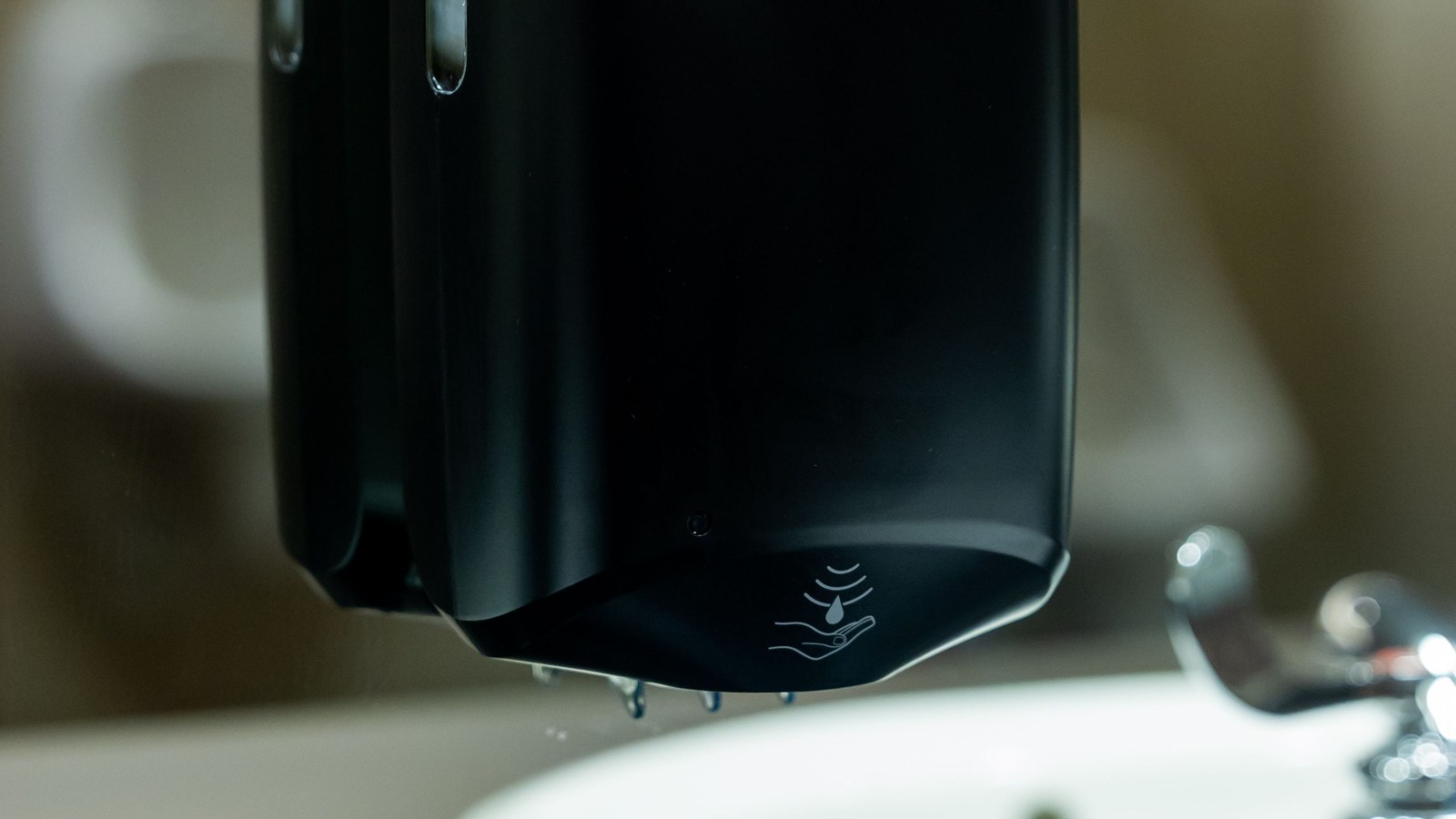
An automatic soap dispenser releases soap when it detects a hand, so there is no pump to press. This guide explains how the sensor and delivery system work, how liquid and foam designs differ, and what to check before choosing or maintaining one.
On this page 12 sections
- What Is an Automatic Soap Dispenser?
- How Does an Automatic Soap Dispenser Work?
- Types and Useful Features
- Benefits and Limitations of Touchless Dispensing
- Where Are Automatic Soap Dispensers Used?
- Automatic Versus Manual Dispensers
- How to Choose and Set One Up
- Common Problems and Manual-Guided Maintenance
- Frequently Asked Questions
- Important Points / Key Information
- Examples / Supporting Information
- Conclusion
Part of our computer hardware technology guide library
What Is an Automatic Soap Dispenser?
An automatic soap dispenser is a soap-delivery device that begins dispensing when its sensor recognises a nearby object, usually a hand. Unlike a manual pump, it combines a sensor, controller, delivery mechanism, and power source.
Automatic is not automatically better for every sink. A manual pump is simpler and needs no electrical power; choose based on soap format, placement, refills, and upkeep.
How Does an Automatic Soap Dispenser Work?
The unit senses a hand, a controller activates, and a delivery mechanism releases soap. Parts and timing vary, so use the individual manual for operation and care.
Reflected infrared hand detection
Many touchless dispensers use reflected infrared light. An emitter sends infrared light outward; a hand in front of the unit reflects some of it back to a receiver. The resulting signal tells the unit that something is present. It is presence detection, not biometric recognition.[1]
Returned light can change with object surfaces and surrounding light. A dirty sensor window, nearby item, or strong light may affect a model. simplehuman lists obstructions, lighting, sensor residue, soap particles, viscosity, and power as checks for one battery-operated pump.[2] Start with accessible exterior checks and the manual.
The controller and powered delivery system
Once sensing meets the model’s activation rule, a controller runs the delivery cycle. Many liquid designs use a powered pump, but not every dispenser has the same fixed pulse or repeat pattern.
One TOTO manual diagrams a sensor, controller, soap and air components, and its own repeat/stop logic in a mousse-style design.[5] It is an example, not a setting to transfer. simplehuman’s variable dispensing is likewise model-specific.[3]
Liquid, foam, and air mixing
A liquid dispenser moves compatible liquid soap. A foam dispenser uses a foam formulation and may combine soap solution with air at or before the nozzle. TOTO’s separate soap and air paths are one design example.[4][5]
Do not assume liquid soap belongs in a foam unit, or that all foam products work in all foam units. simplehuman uses purpose-formulated foam soap, and TOTO restricts soap for its documented model.[4][5] Never alter product compatibility unless the exact manual and soap label specify it.
Power depends on the model
Automatic operation needs electricity, but power methods vary: replaceable batteries, built-in rechargeable batteries, or a specified DC arrangement. DC identifies electrical form, not proof of batteries.
simplehuman has replaceable-battery and built-in rechargeable examples; TOTO has a DC-powered model.[2][3][6] These do not establish universal battery life. Check the approved arrangement and care instructions for the room.
Types and Useful Features
Categories overlap: a unit can be countertop and refillable, wall-mounted and cartridge-based, or foam-capable with adjustable output. Choose soap format first.
Liquid versus foam dispensers
Foam changes texture and delivery, not the fundamentals of handwashing. Reviewed guidance focuses on soap, rubbing, rinsing, and drying—not one superior texture.[7]
| Consideration | Liquid-soap dispenser | Foam-soap dispenser |
|---|---|---|
| Intended product | Model-compatible liquid soap | Model-compatible foam soap or specified formulation |
| Delivery | Powered pump moves liquid soap | Foam system may use a soap-and-air design |
| Key check | Confirm viscosity and manufacturer restrictions | Confirm the exact foam format; do not improvise product preparation |
| Hygiene expectation | Requires correct handwashing | Foam is not automatically more hygienic than liquid soap |
Mounting, refills, and controls
Countertop units are easier to move; wall-mounted units can clear space. Either may use a refillable tank or cartridge. Refillable tanks need careful product matching and manual-guided cleaning; cartridges may tie the unit to a refill system.
A removable reservoir, controlled tank access, a tamper-resistant spout, or dose control can matter in shared spaces.[3][6] They do not prove better hygiene or efficiency.
Benefits and Limitations of Touchless Dispensing
The direct benefit is hands-free soap delivery. That can help when hands are messy, in a shared washroom, or when a manual pump is hard to press.
The limitation is just as important. Touchless describes how soap is delivered; it does not wash, sanitise, or sterilise hands by itself, and it does not guarantee that a person will avoid infection. CDC guidance says to wet hands with clean running water, apply soap, lather and scrub all hand surfaces for at least 20 seconds, rinse, and dry.[7] The World Health Organization’s 40–60 seconds refers to the entire handwashing procedure, not 40–60 seconds of scrubbing alone.[8]
Do not assume a sensor unit will reduce soap, water, costs, or waste in every setting. Those outcomes depend on the actual dose, product, refill system, maintenance, and how people use the sink.
Where Are Automatic Soap Dispensers Used?
At home, a touchless dispenser can sit by a bathroom or kitchen sink when its reservoir and power arrangement fit. Kitchens can collect splashes; bathrooms need a stable location within the model’s stated water-exposure limits.
Offices, schools, restaurants, and public washrooms add service questions: who refills, cleans, obtains compatible refills, and maintains power? A shared facility may value wall mounting, controlled tank access, or easy external care.[6]
Healthcare settings also need the facility’s infection-control policy. CDC clinical guidance says not to add soap to a partially empty liquid-soap dispenser; in that healthcare context, topping off has been associated with pathogenic-bacteria outbreaks and can lead to bacterial contamination.[9] This is not a finding that every consumer refillable dispenser is unsafe. It is a reason to follow a documented refill process instead of mixing fresh product into leftover product.
Automatic Versus Manual Dispensers
Neither option guarantees better hygiene, lower cost, or fewer problems. Match it to the site and the people maintaining it. For related products, visit the hardware category .
| Decision point | Automatic dispenser | Manual dispenser |
|---|---|---|
| Operation | Sensor triggers a powered delivery cycle | User presses a mechanical pump |
| Power | Needs a model-specific battery, rechargeable system, or stated external supply | Usually needs no electrical power |
| Soap compatibility | May have liquid/foam, viscosity, or approved-refill limits | Still needs compatible soap, with fewer electronic constraints |
| Upkeep | External sensor/nozzle care plus power and refill checks | Exterior nozzle and pump cleanliness plus refill checks |
| Trade-off | Hands-free delivery with more components to match and maintain | Simpler operation with direct contact at the pump |
How to Choose and Set One Up
Choose from the model’s specifications. Confirm liquid or foam format, permitted soap or refill, capacity, external-care steps, stated water resistance, and serviceable parts.
Read the power details. A replaceable-battery pump may name an accepted battery type; that does not make rechargeable cells appropriate. A rechargeable product needs its stated charging method. DC alone does not say batteries are included or suitable.[2][3][6]
Use only the manual’s approved mounting, placement, and power instructions. Do not guess mounting dimensions, bypass a supply line, open the pump, or probe internal components. Fill with the compatible product, keep the exterior dry where directed, and test normal hand detection after placement.
Common Problems and Manual-Guided Maintenance
Check apparent faults from the outside. For no output, confirm compatible product and power. For inconsistent or unexpected dispensing, clear nearby items, consider lighting, and clean only accessible sensor and nozzle surfaces as directed.[2]
Nozzle residue can affect operation. Follow the individual manual, because cleaning directions differ. One simplehuman pump specifies a damp cloth followed by a dry cloth.[2] Keep water away from electrical or pump areas where the manual requires it, as TOTO’s example does.[5]
Do not solve a thick-soap or output problem through improvised dilution, internal disassembly, or a tool pushed into the nozzle or lines. Use compatible soap, verify an available dose setting according to the manual, and seek manufacturer service guidance if external checks do not resolve the problem.
Frequently Asked Questions
Can I put any liquid soap in an automatic dispenser?
No. Check the label and manual. Some products limit viscosity, particles, or approved soap types, and foam systems may require their own formulation.[2][4][5]
Is foam soap better than liquid soap in a sensor dispenser?
They are different delivery formats. The reviewed evidence does not show that foam is inherently more hygienic; use the format your dispenser is designed to deliver and follow the full soap-and-water method.[4][7]
Do all automatic dispensers use batteries?
No. Products may use replaceable batteries, a built-in rechargeable battery, or a specified DC power arrangement. DC power does not automatically mean battery power.[2][3][6]
How should I clean an automatic soap dispenser?
Clean only accessible exterior surfaces, the sensor window, and the nozzle using the model’s approved method. Do not immerse, open, or probe the internal pump or electronics unless the manufacturer specifically authorises service.[2][5]
Why does the dispenser miss my hand or dispense by itself?
Sensor residue, an obstacle, strong lighting, power, or placement may contribute. Clear the area and use the model’s troubleshooting guidance before assuming sensor failure.[1][2]
Important Points / Key Information
An automatic dispenser is a controlled soap-delivery device, not a hygiene guarantee. Its sensor detects a nearby hand, its controller applies model-specific logic, and its delivery system releases a compatible product.[1][5] The best fit is one with the right soap format, power method, accessible external care, and instructions you can follow.
Touchless use reduces contact with the pump surface, but clean hands still depend on thorough washing. Scrub with soap for at least 20 seconds under CDC public guidance; WHO’s 40–60 seconds measures the whole procedure.[7][8]
Examples / Supporting Information
The supplied manufacturer materials show several design patterns: a battery-operated liquid sensor pump, a rechargeable liquid pump, a foam dispenser using a purpose-formulated product, and a DC-powered commercial unit.[2][3][4][6] These are examples, not a ranked shortlist or hands-on test. Their differences are why a battery rule, cleaning method, soap choice, or dose expectation should not be carried from one dispenser to another.
A home setup might be a countertop liquid unit whose owner uses compatible soap, wipes accessible surfaces as directed, and checks power and splash guidance. A shared facility may instead prioritise wall mounting, controlled refill access, and a written maintenance routine. In healthcare, that routine must also follow the facility’s infection-control policy, including CDC guidance against topping off partly empty liquid-soap dispensers.[9]
Conclusion
Choose an automatic soap dispenser as a maintainable appliance, not as a promise. Confirm the liquid or foam format, refill rules, power design, placement limits, and approved external cleaning method before bringing it to the sink. Used with compatible soap and correct handwashing, a touchless dispenser can make soap easier to access without overstating what the technology can do.
How we checked thisSources (9)
We keep source links private so your reading stays on techduopulse. Each note names the publisher and document we checked.
Vishay Semiconductors — Vishay Infrared Receivers for Presence Sensor Applications (29 October 2024)
Primary source · Presence-sensor mechanismsimplehuman — Product Support: 8 oz. sensor pump (undated)
Primary source · Model-specific sensor-pump support and external caresimplehuman — Liquid Sensor Pump (undated)
Primary source · Rechargeable liquid pump and variable dispensing examplesimplehuman — Sensor Pump Foam (undated)
Primary source · Foam formulation and dispensing exampleTOTO — Automatic Soap Dispenser Owner’s Manual (April 2009)
Primary source · Model-specific air/soap paths, control logic, compatible soap, and safe external careTOTO — Sensor-Operated Soap Dispenser: DC (undated)
Primary source · DC-powered commercial dispenser exampleCDC — About Handwashing (undated)
Primary source · Public handwashing technique and 20-second scrubbing guidanceWorld Health Organization — How to handwash? (undated)
Primary source · Whole-procedure handwashing durationCDC — Clinical Safety: Hand Hygiene for Healthcare Workers (undated)
Primary source · Healthcare liquid-soap dispenser refill safetySource-backed owner-approved manual edition; genuine contextual photograph; no hands-on test claimed.