When you press a smartphone shutter button, the result is rarely a simple record from one sensor exposure. It is usually the output of a computational imaging pipeline: a sequence of capture, alignment, colour, noise, detail, and rendering decisions. Understanding that pipeline makes camera comparisons more useful. It explains why two phones with similar-looking hardware can create noticeably different photos, and why one scene can reward different camera modes.
This article is part of the consumer technology guide library.
Light begins the process, not the finished image
A camera sensor is a grid of photodiodes, semiconductor elements that turn incoming photons into electrical charge. Colour filters above them sample different portions of light, commonly in a Bayer pattern. Because each location initially records only one filtered colour value, the camera must estimate full red, green, and blue values for every output pixel. This reconstruction step is called demosaicing.
Small phone cameras work under physical constraints. A compact lens and small pixels collect limited light, which can make low-light data noisy and bright areas easier to clip. Computation does not erase those constraints; it manages their consequences. Lens quality, sensor behaviour, focus, motion, and available light still shape what information enters the pipeline. Software can make choices about imperfect data, but cannot recover scene detail that was never captured.
The image signal processor turns measurements into colour
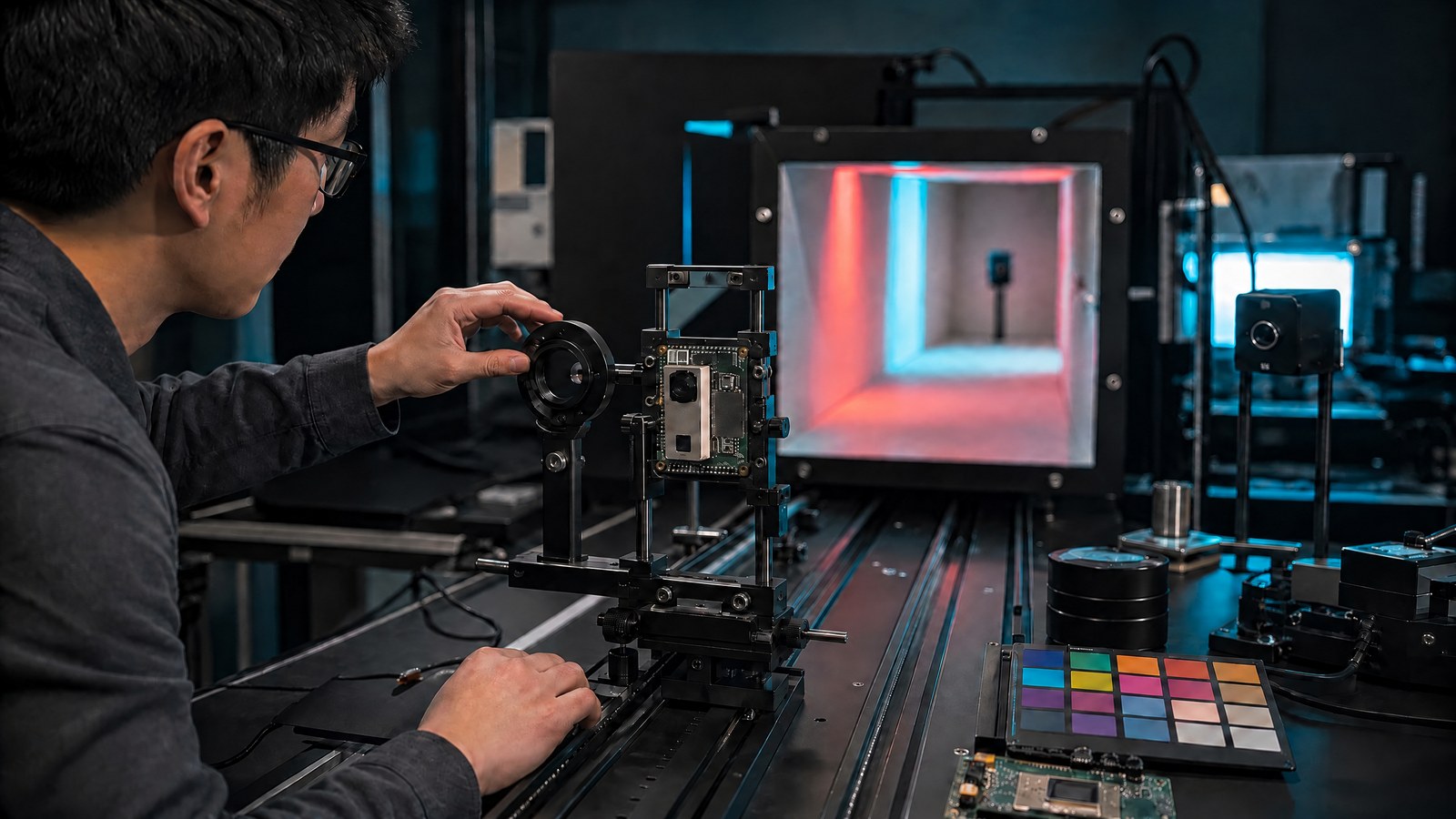
An image signal processor, or ISP, is dedicated hardware that transforms sensor data into an image quickly. Typical stages can include correcting sensor artefacts, estimating white balance, demosaicing, reducing noise, adjusting colour, sharpening, and converting the image into a display-oriented colour space. The order and tuning of those stages influence the result, so camera quality cannot be inferred from sensor resolution alone.
White balance is a useful example. It estimates how a scene’s illumination should affect colour so that familiar objects appear plausible under different light sources. This is an interpretation, not a perfect measurement of what a person saw. Likewise, noise reduction can make a dark image appear cleaner but may soften fine texture. The useful question is whether the processing fits the scene and the photographer’s intent, rather than whether processing occurred at all.
Many phone photos combine more than one frame
Multi-frame photography captures several images close together and combines them. The frames must be aligned because hands and subjects can move between exposures. When alignment works, combining frames can reduce random noise and preserve information across bright and dark regions. This is why a phone may take a moment after the shutter press: it may be selecting, registering, and merging data rather than simply writing one frame.
Google Research’s HDR+ paper describes a mobile pipeline that captures, aligns, and merges a burst of constant-exposure raw frames to reduce noise and increase dynamic range. Dynamic range is the span between useful shadow and highlight detail. The approach also illustrates a trade-off: moving subjects or camera motion complicate alignment. A multi-frame image may look better in difficult light, but fast motion can still produce artefacts or a less natural result.
HDR and night modes solve different capture problems
High dynamic range, or HDR, aims to retain useful information in both bright and dark parts of a scene. A phone may choose an exposure that protects highlights and then lift shadow information through multi-frame processing and tone mapping. Tone mapping compresses a wide brightness range into the narrower range a display or file can show. It is a rendering choice as well as a technical necessity.
Night modes also seek more usable signal, but their timing is especially sensitive to movement. Longer or multiple exposures can brighten a dark scene and reduce noise, while motion can blur the image or make frame merging unreliable. Research on mobile computational photography describes motion-aware capture strategies for low light. The outcome is not a literal substitute for more light: it is a calculated balance between exposure, noise, motion, and rendering.
Portrait blur and zoom are computed interpretations
Portrait blur often simulates shallow depth of field by estimating which areas belong to a person or object and applying different treatment to foreground and background. That estimate is called segmentation. It can make a portrait easier to read, but it may make mistakes around hair, glasses, fingers, transparent objects, or overlapping subjects. The effect should be understood as a creative rendering, not as direct optical blur from a larger lens.
Digital and hybrid zoom also depend on computation. Cropping uses fewer sensor samples, while multi-frame merging, upscaling, or information from another camera may help build a larger output. These techniques can improve the usefulness of a distant subject, yet they cannot make every crop equivalent to capture with a longer focal length. Fine repeating textures, low light, and subject movement remain demanding conditions for both optics and algorithms.
Compare cameras by scenes and priorities
For everyday decisions, compare images from scenes that matter to you: people in mixed light, moving children or pets, backlit windows, close objects, and indoor colour. Inspect faces, edge transitions, texture, highlights, and motion rather than relying only on a single overall impression. If possible, view original files on a larger display, because small screens can hide noise reduction, sharpening halos, or errors in depth estimation.
There is no universally correct smartphone rendering. Some people prefer bright shadows and vivid colour; others prefer restrained contrast or less smoothing. Use repeatable scenes and decide which compromises you accept. The pipeline perspective keeps the comparison honest: hardware establishes the raw opportunity, and computational choices determine how that opportunity becomes the photograph you receive.
Source notes
Reporting record
techduopulse stores source destinations privately. Public notes remain non-clickable so every visitor journey stays on this website.
HDR+ mobile imaging paper
Primary source · Multi-frame capture and fusionMobile computational photography overview
Context source · Camera imaging pipelineImage updated: embedded writing removed; article content and factual claims unchanged.