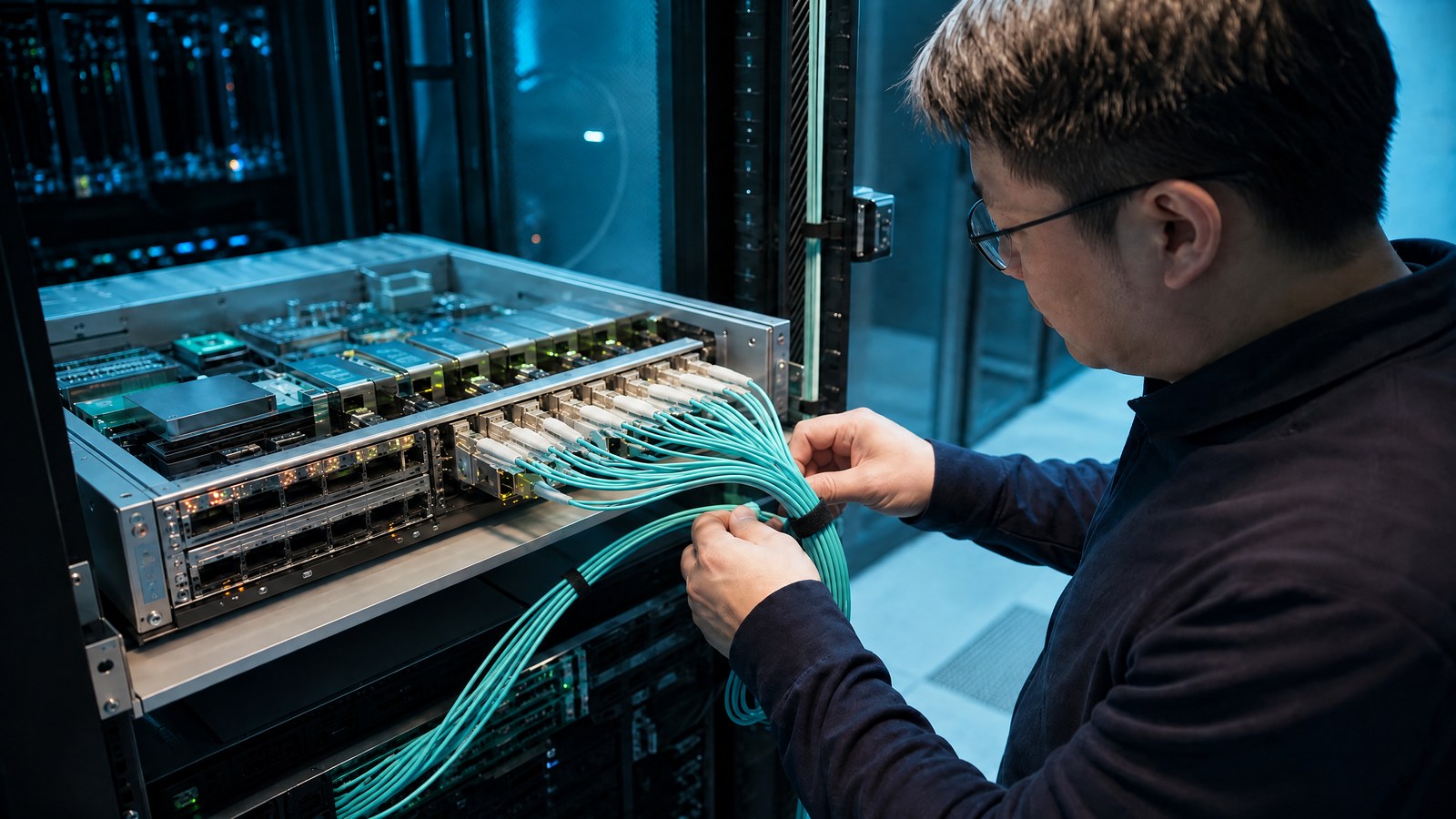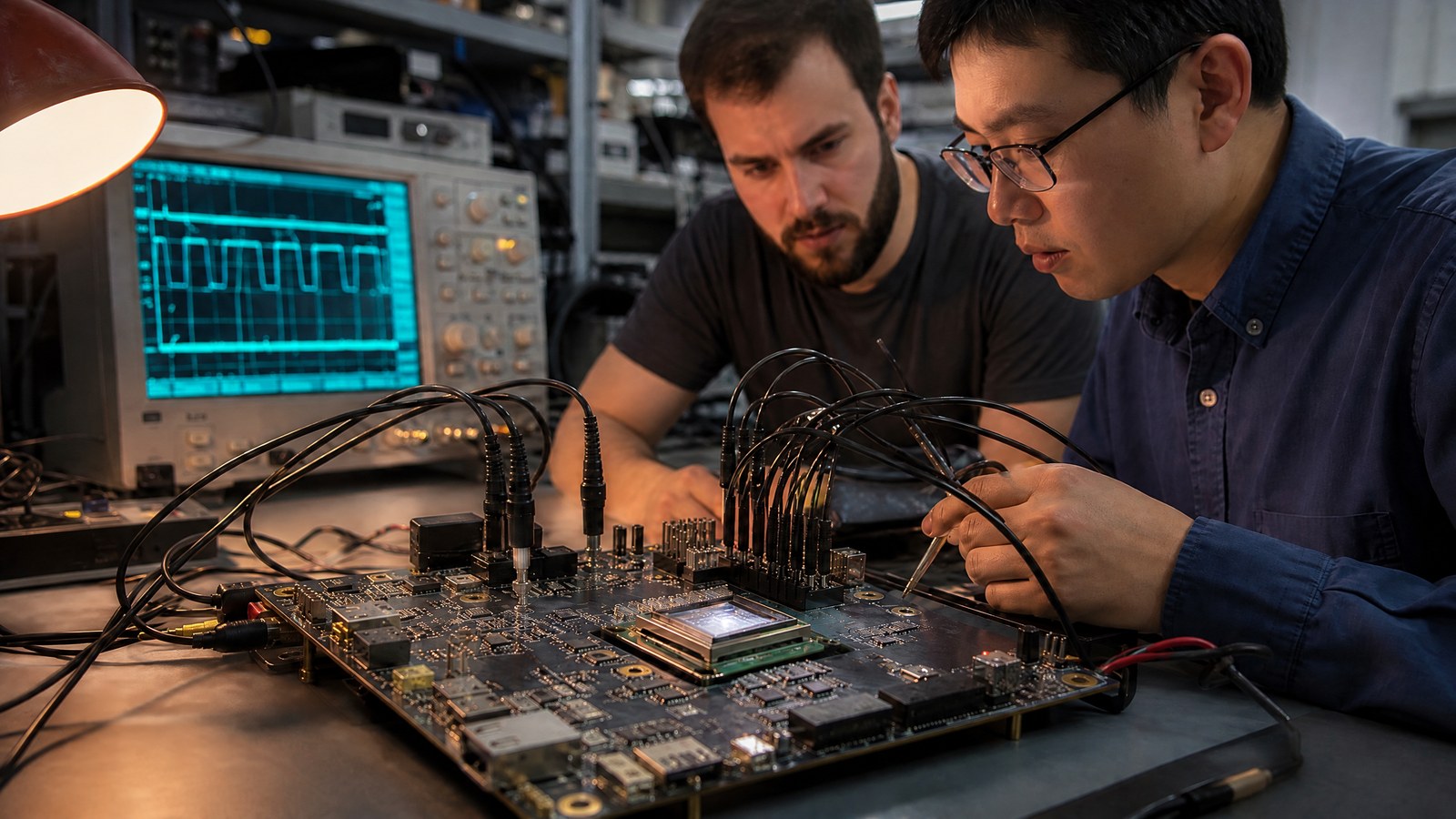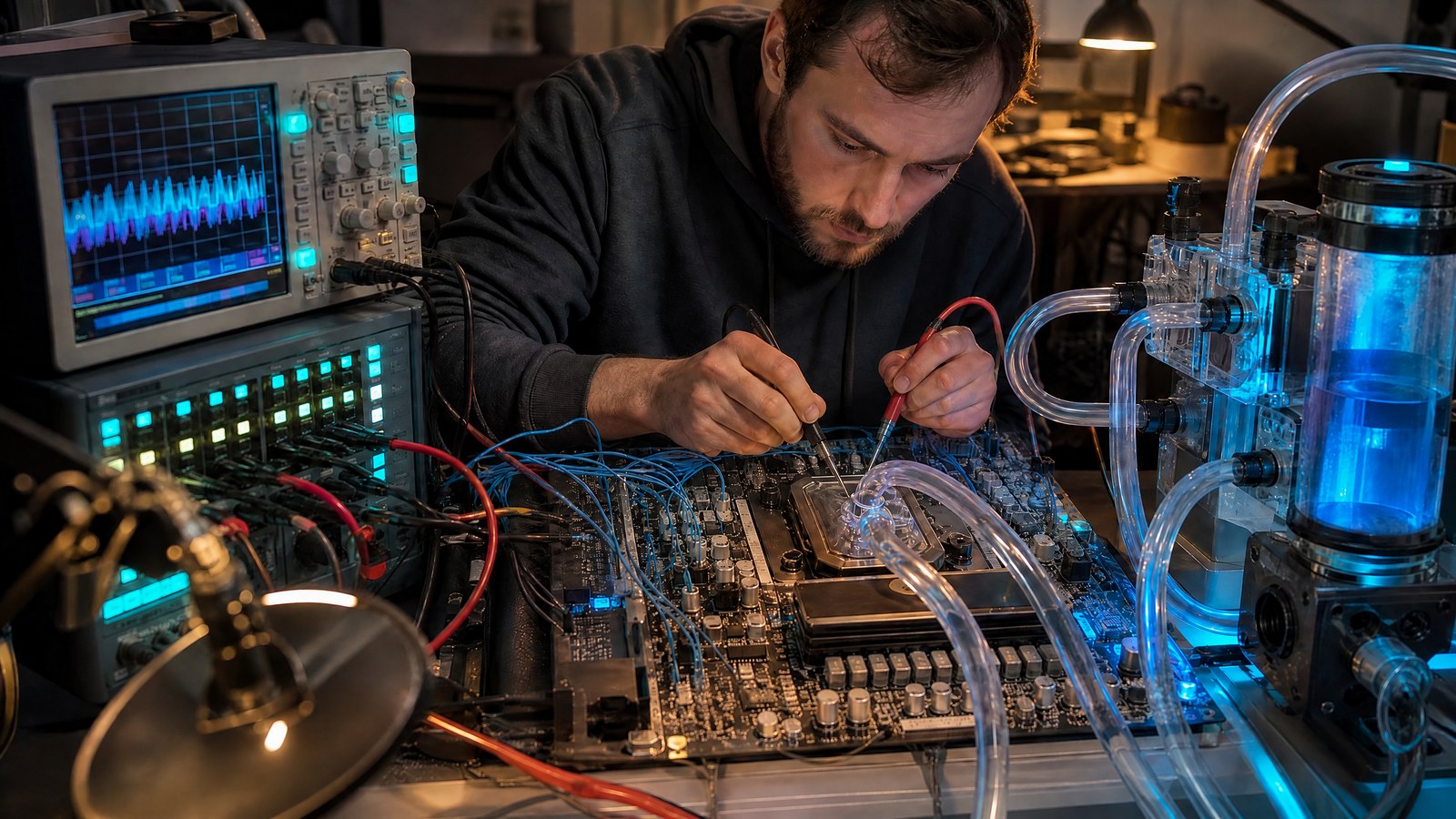
A processor can execute instructions only while its electrical and thermal conditions remain within design limits. That makes power delivery and cooling part of the computing system, not accessories added after the processor is chosen. A workload can change current demand quickly; voltage regulators and the power-delivery network must respond without unacceptable variation. The electrical energy that becomes heat must then cross interfaces, coolers, air or liquid loops, and the equipment environment. Each stage constrains sustainable behaviour.
This article is part of the computer hardware technology guide library.
Power arrives through a chain, not a single wire
A processor’s power path runs from the facility or system supply through conversion stages, board planes, connectors, voltage regulators, package connections, and on-die distribution. A voltage-regulator module, or VRM, converts an input rail to the tightly controlled voltage a processor domain needs. The power-delivery network includes the conductors, capacitors, regulators, and control behaviour that determine how voltage responds as load changes. Its job is to keep delivered power within the processor’s specified operating envelope.
This chain has electrical losses and response limits. Resistance creates voltage drop and heat; inductance resists rapid current change; regulators and capacitors have finite control and energy-storage behaviour. A processor that changes activity can therefore stress the local delivery system even when the average system power appears reasonable. Good design considers steady load, transients, protection behaviour, startup, fault conditions, and interactions with neighbouring loads. It is a coordination problem spanning silicon, package, board, and power architecture.
Current transients are a system event
A current transient is a rapid change in the current a device draws. If delivery cannot respond quickly enough, the local voltage can dip or overshoot. The exact acceptable excursion is processor-specific, which is why platform designers follow detailed electrical specifications rather than applying a universal rule. Capacitors near the load can supply or absorb energy over short intervals, while regulators adjust over their control timescale. Layout and return paths matter because they shape the impedance seen by the load.
Protection must be designed as part of the normal operating story. Overcurrent limits, thermal signals, power-good sequencing, and voltage-regulator responses can prevent damage or instability, but overly aggressive settings can also restrict performance or cause unnecessary resets. Intel’s thermal guidance notes that a system-on-chip package integrates multiple compute and input/output functions, and that concurrency power may need consideration in sustained power-delivery and thermal capability. The platform must be sized for the combination, not just one block in isolation.
Every watt becomes a heat-removal task
Electrical power consumed by a processor ultimately appears largely as heat within the system. The thermal path usually includes the silicon, package, thermal interface material, heat spreader or cold plate, heat sink or liquid loop, and the surrounding air or facility water infrastructure. Thermal resistance describes how much temperature rise occurs for a given heat flow through a path. Lower resistance can help, but the entire route matters; improving one interface cannot overcome a severe restriction farther downstream.
Cooling is also spatial. A chip can have local hotspots even when the package-average temperature appears acceptable. Package placement, heat-spreader design, cooler contact, airflow distribution, coolant flow, and neighbouring components all affect local conditions. Advanced packages can make this more complex by concentrating several active dies in a small area. Responsible thermal design uses the vendor’s limits and system measurements or models to examine steady and transient conditions, rather than treating a nominal cooler rating as a complete answer.
Power limits and temperature limits interact
Processors use control mechanisms to manage performance against power, current, and temperature constraints. Intel’s processor documentation describes base power as the assured sustained power used to design a thermal solution and notes that opportunistic higher-frequency operation depends on conforming to temperature, power, power-delivery, and current-control limits. This illustrates a general principle: a processor’s observed frequency is often the result of several control boundaries acting together, not one simple clock setting.
A cooling system with more thermal headroom may permit longer periods of higher activity where the processor’s policies allow it, but it does not override electrical or firmware limits. Conversely, a robust VRM cannot compensate for an undersized heat path. System builders should avoid reading a single power label as either a guaranteed peak draw or a complete thermal requirement. The relevant design information includes sustained conditions, transient behaviour, workload mix, control policy, and the temperature of the actual operating environment.
Air and liquid cooling are environment choices
Air cooling moves heat from components into the chassis airflow and then to the room or facility. Its effectiveness depends on inlet temperature, fan capability, obstruction, pressure, recirculation, and altitude. Liquid cooling can move heat through a cold plate and fluid loop, potentially changing the local thermal path and heat-rejection design. Neither method is inherently suitable for every processor density. The selection depends on component heat flux, rack arrangement, maintainability, facility infrastructure, and the permitted operating envelope.
ASHRAE’s equipment thermal guidance distinguishes recommended and allowable operating ranges and includes a high-density air-cooled server class. It also defines liquid-cooling facility-water classes. These are environmental frameworks, not a substitute for an individual product’s requirements. “Allowable” describes tested functionality conditions, not a blanket reliability promise. The practical implication is that cooling design begins with the equipment’s declared class and limits, then checks inlet conditions, humidity, change rates, and facility behaviour under the intended load.
Validate the platform rather than a component
A useful validation plan joins electrical and thermal evidence. Confirm regulator settings and sequencing; observe voltage behaviour under representative load transitions; check protection and recovery paths; verify cooler installation and contact; and measure or model inlet and component temperatures under sustained operation. The goal is to establish margins for the assembled platform. Testing only a processor or only a VRM on an ideal bench can miss the coupling introduced by the real board, chassis, cable routing, airflow, and firmware configuration.
The Open Compute Project’s power-distribution work frames its objective around power density, efficiency, reliability, safety, and scalability, including direct-current architectures and protection interfaces. That systems framing is the right mindset for modern processors. Performance is not merely a silicon characteristic delivered intact to a server. It is an operating result supported by conversion, distribution, control, cooling, and environmental management. Treating those layers together produces more dependable and interpretable hardware decisions.
Source notes
Reporting record
techduopulse stores source destinations privately. Public notes remain non-clickable so every visitor journey stays on this website.
Intel processor thermal and power design guidance
Primary source · Base power, turbo residency, thermal solution, current and power-delivery limitsASHRAE thermal-guidelines reference card
Primary source · Air and liquid environmental classes, recommended and allowable conditionsOCP power-distribution project scope
Primary source · Power density, efficiency, reliability, safety, protection interfaces, and scalabilityImage updated: embedded writing removed; article content and factual claims unchanged.