
PM-WANI Public Wi-Fi Explained: How Hotspots Work in India
This article is part of the software engineering technologies guide library.
What PM-WANI is—and what it is not
PM-WANI stands for Prime Minister Wi-Fi Access Network Interface. It separates functions that one conventional provider might run together, enabling different participants to interoperate. [1]
It is not a home broadband plan, a mobile carrier or a government guarantee of free internet. DoT reported 409,403 PDOs/public Wi-Fi hotspots across states and union territories as of 28 February 2026. That dated aggregate is not a live availability map or service-quality promise for a bus stand, market or village. [4]
For a broader decision about when your phone should use cellular data or Wi-Fi, see TechDuoPulse’s smartphone connectivity guide. PM-WANI adds a public-service and provider-layer question to that everyday connection choice.
The four roles behind a hotspot
The four roles explain why an app, location or payment option can differ.
### Public Data Office (PDO): the local access point
The PDO is the local participant operating WANI-compliant access points. It obtains internet through licensed telecom or internet service providers and works with a PDOA for aggregation, authorisation and accounting. [2] [3]
A PDO may run more than one access point. An ordinary router is not necessarily a PM-WANI hotspot; rely on a compatible app or venue identification.
### Public Data Office Aggregator (PDOA): authorisation, plans and accounting
The PDOA brings together PDO access points. Its captive portal authorises a session, presents packs to a new customer, processes payment, activates the pack and keeps the usage account in the typical flow. [3]
Prices and pack choices are therefore not nationally fixed. A PDOA declares subscriber tariffs and may integrate UPI, e-wallets, cards or online banking; that does not promise every option at every hotspot. [3]
### App Provider: the app that registers and discovers
An App Provider maintains the app and authentication service. In the standard flow, a user creates a profile, verifies a mobile number by one-time password, and sees nearby WANI-compliant access points. [2] [3]
Do not expect one universal government app or universal access. Check the exact app’s hotspots, pack information and support details before relying on it.
### Central Registry: participant and interoperability records
The Central Registry keeps participant details and supports interoperability; C-DOT was named as its initial operator. It is not a guarantee that a listed location has working bandwidth at a given moment. [1] [3]
A typical user journey: discover, authorise, pay and connect
The official guidelines describe a typical, not universal, sequence:
Install and open a compatible App Provider app, then create a profile and complete mobile-number verification.
Use the app to look for WANI-compliant hotspots shown nearby.
Choose one access point. The hotspot asks the relevant PDOA captive portal to authorise the session, while the app’s provider authenticates the user.
If you are new to that PDOA, review the available data packs and their tariff, then choose a pack.
Complete payment through the options presented by that PDOA. After payment, the PDOA registers the subscriber, activates the pack and permits the internet session. An existing customer with sufficient balance may not see the same payment step. [3]
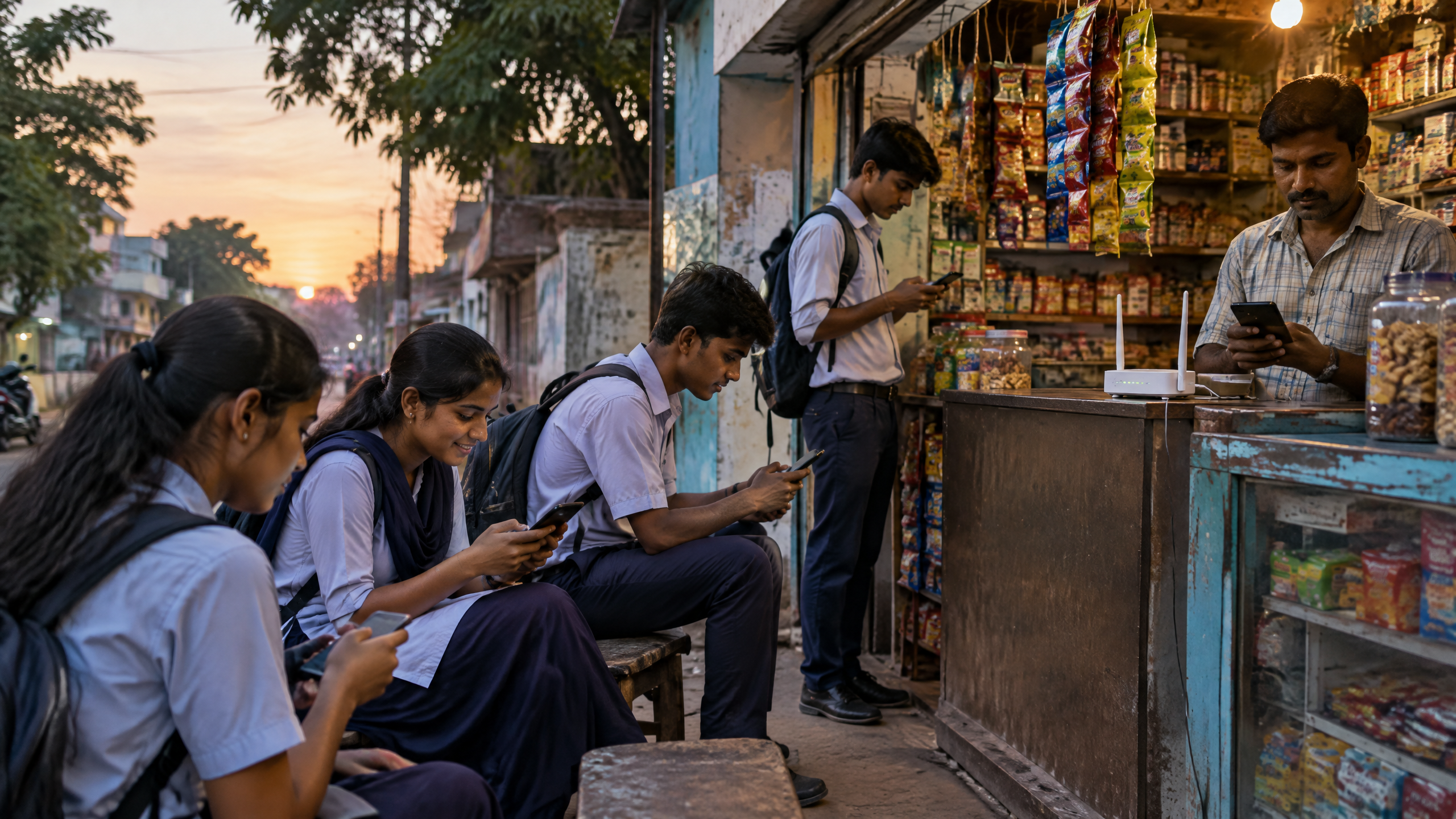
Example: A student near a participating business may see a hotspot, choose a PDOA’s short pack and connect after payment. This illustrates the flow; it does not prove a hotspot, price, UPI option or signal is available at every business or town.
Before paying, check the displayed price, allowance, validity, support terms and payment method. This article cannot verify any individual offer.
Why PM-WANI matters in India—and why it has practical limits
Public Wi-Fi can offer another route online for rural or low-connectivity communities, local entrepreneurs and people needing modest access away from their usual connection. The government describes PM-WANI as decentralised and market-driven and says it is pursuing rural and remote growth. [4]
But a hotspot needs backhaul, power, maintenance, an operational provider arrangement and local demand. Location, device compatibility and shared use can affect the experience. It may suit messages but not a time-sensitive call, large upload or outage-sensitive task.
In June 2025, DoT welcomed a TRAI tariff rule that capped the price charged to PDOs for certain retail FTTH plans at no more than twice the corresponding consumer price. That rule concerns upstream connectivity costs for PDOs; it does not set a single consumer PM-WANI price or guarantee a cheaper pack at a particular hotspot. [5]
The framework permits PDOA roaming agreements, and later DoT communications describe roaming as enabled. This remains a capability, not proof that every account will roam at every hotspot. [3] [5]
What to check before you depend on a hotspot
Treat a PM-WANI hotspot as one possible connection, not an assumed substitute for mobile service or home broadband.
Nearby availability: See whether the compatible app actually shows a hotspot where you are. A national or state figure cannot answer this.
The on-screen offer: Confirm the current pack, price, allowance, validity, accepted payment method and any stated session conditions before paying.
Basic usability: Check whether the connection reaches the service you need. Signal bars or a Wi-Fi icon alone do not prove usable internet.
A fallback: Keep an alternative for a deadline or essential communication.
Support path: If payment completes but access does not start, use the app or PDOA support information presented in the service rather than assuming every venue can resolve account-side issues.
This is not a wireless-performance article. For why a Wi-Fi 7 label cannot predict real throughput or latency, read Wi-Fi 7 performance still depends on spectrum, interference and client design. The question here is whether public access is present and how its user journey works.
Google Trends context: useful restraint, not a demand claim
Google Trends was checked for India over 30 days and 12 months using PM WANI hotspot, public Wi-Fi India, PM WANI app provider and PDO Wi-Fi hotspot India. The primary PM-WANI and PDO queries had no usable time series; public Wi-Fi India was sparse over 12 months and empty over 30 days.
That does not show no public interest or establish a state ranking. Trends is sampled, normalized relative interest, not search volume; 100 is a selected-comparison peak, not “100 searches.” Sparse results cannot support popularity, volume, difficulty, breakout or local-demand claims. Those findings are not verified and are not used as article claims. [6]
Frequently asked questions
### Is PM-WANI free Wi-Fi?
Not necessarily. The framework allows PDOAs to declare subscriber tariffs and present data packs. A specific hotspot may have its own pack and payment options, so check the on-screen offer rather than assuming free access. [3]
### How do I find a PM-WANI hotspot?
Use a compatible App Provider app to look for nearby WANI-compliant access points. The app-discovery model is part of the framework, but a result depends on nearby participating and working hotspots. [2] [3]
### Do I need the same app at every PM-WANI hotspot?
Do not assume so. The framework includes App Providers and can support interoperation, but the available app, account flow and roaming arrangement can vary. Check the service shown at the location.
### Who sets the PM-WANI data-pack price?
The PDOA declares tariffs for subscribers under the guideline. Therefore, there is no single nationwide public retail price that this article can quote. [3]
### Can a local business become a PM-WANI hotspot?
A local operator may act as a PDO with internet connectivity and a PDOA relationship. Requirements can change, so consult current DoT materials and qualified advice rather than treating this explainer as compliance guidance. [2] [3]
Frequently asked questions about PM-WANI public Wi-Fi
These short answers summarise the practical scope of this explainer. Service availability, eligibility and implementation details can change, so check the current official guidance before acting.
What is PM-WANI public Wi-Fi?
PM-WANI Public Wi-Fi Explained: How Hotspots Work in India explains the purpose, user experience and practical limits of PM-WANI public Wi-Fi in India.
Who can use PM-WANI public Wi-Fi?
Eligibility depends on the service, the user profile and the current rules or implementation of the participating organisation.
What should users check before using it?
Check the identity, consent, privacy, eligibility and support information shown by the service. Do not share sensitive information with an unverified person or interface.
Is PM-WANI public Wi-Fi available everywhere?
Coverage and features may vary by state, department, institution, provider, device and rollout stage. Treat availability as status-labelled rather than universal.
Source notes
Reporting record
techduopulse stores source destinations privately. Public notes remain non-clickable so every visitor journey stays on this website.
https://www.pib.gov.in/PressReleasePage.aspx?PRID=1679342
Primary source · Research source 2https://www.eservices.dot.gov.in/pm-wani-service-authorisation
Primary source · Research source 3https://www.eservices.dot.gov.in/sites/default/files/2024-11/PM-WANI_Guidelines.pdf
Primary source · Research source 4https://www.dot.gov.in/static/uploads/2026/04/32bddfeaf26b0921914c8191c588633d.pdf
Primary source · Research source 5https://www.pib.gov.in/PressReleasePage.aspx?PRID=2083228
Primary source · Research source 6https://www.pib.gov.in/PressReleasePage.aspx?PRID=2136754
Primary source · Research source 7https://support.google.com/trends/answer/4365533?hl=en
Primary source · Research source 8https://developers.google.com/search/docs/appearance/structured-data/article
Primary source · Research source 9https://developers.google.com/search/docs/appearance/structured-data/breadcrumb
Primary source · Research source 10https://developers.google.com/search/updates
Primary source · Research source 11New India-focused explainer covering PM-WANI public Wi-Fi, user context, limitations and verified sources.