
DIGIPIN Article Package
This article is part of the software engineering technologies guide library.
What a DIGIPIN represents
India Post’s design divides an India-focused geographic bounding box into increasingly smaller 4×4 sections. After 10 levels of subdivision, each final cell receives a unique 10-character code. The technical document describes the final cells as approximately 4 metres by 4 metres; their exact dimensions vary with latitude, and it notes a 3.8 m by 3.8 m dimension at the equator. [2]
The code is calculated from latitude and longitude rather than a street name, landmark, person or property record. That makes it stable when a road is renamed, a village develops, or a new building is constructed. It also means the code does not carry a resident’s name, a household relationship, a floor number or a legal status. [1] [2]
India Post designed DIGIPIN for India, including a maritime extent in the system’s bounding box. It is not a universal international addressing code. [1] [2]
### DIGIPIN, PIN code and postal address are different things
| Item | What it refers to | What it does not establish |
|---|---|---|
| DIGIPIN | One small, coordinate-derived location grid | A person, floor, flat, postal-delivery acceptance or address proof |
| PIN code | A broader postal area | An exact entrance, home or field location |
| Postal address | Descriptive details such as house, road, locality and PIN code | A standardised small coordinate grid on its own |
A useful comparison is an apartment block. Two residents on different floors may need different flat numbers in their normal addresses. Their locations can still fall in the same DIGIPIN cell because the code is based on the point on the ground, not on floor or resident. India Post explicitly says a DIGIPIN is a location reference, not a person identifier. [1]
How to find your DIGIPIN
India Post links to an official Know Your DIGIPIN service. The site asks for location access in order to retrieve a code for the device’s location. India Post says a user does not need to create an account or sign in, but needs a device that can provide the relevant location coordinates. [1] [3]
A practical route is simple:
Open the official India Post lookup page, rather than a link forwarded in a message.
Read the location-access prompt and allow access only if you are comfortable using the service at that moment.
Check that the detected point is the place you mean. A phone held on a public road, a neighbouring plot or another side of a building may not represent the intended entrance or unit.
Save or share the returned code only alongside the normal details the receiving organisation needs, such as house or flat number, building, village/locality, road, landmark and PIN code.
India Post has also published the encoding and decoding logic in an open-source repository. In technical integrations, the code is kept as one continuous 10-character identifier; a space-separated 3-4-3 display is allowed for readability, but hyphens are not. [4] This matters more to software builders than to most residents: people using the official lookup page do not need to understand the calculation.
Where a location code may help in India
DIGIPIN can be a useful extra reference in places where an ordinary written address leaves uncertainty about the final spot. Consider these examples:
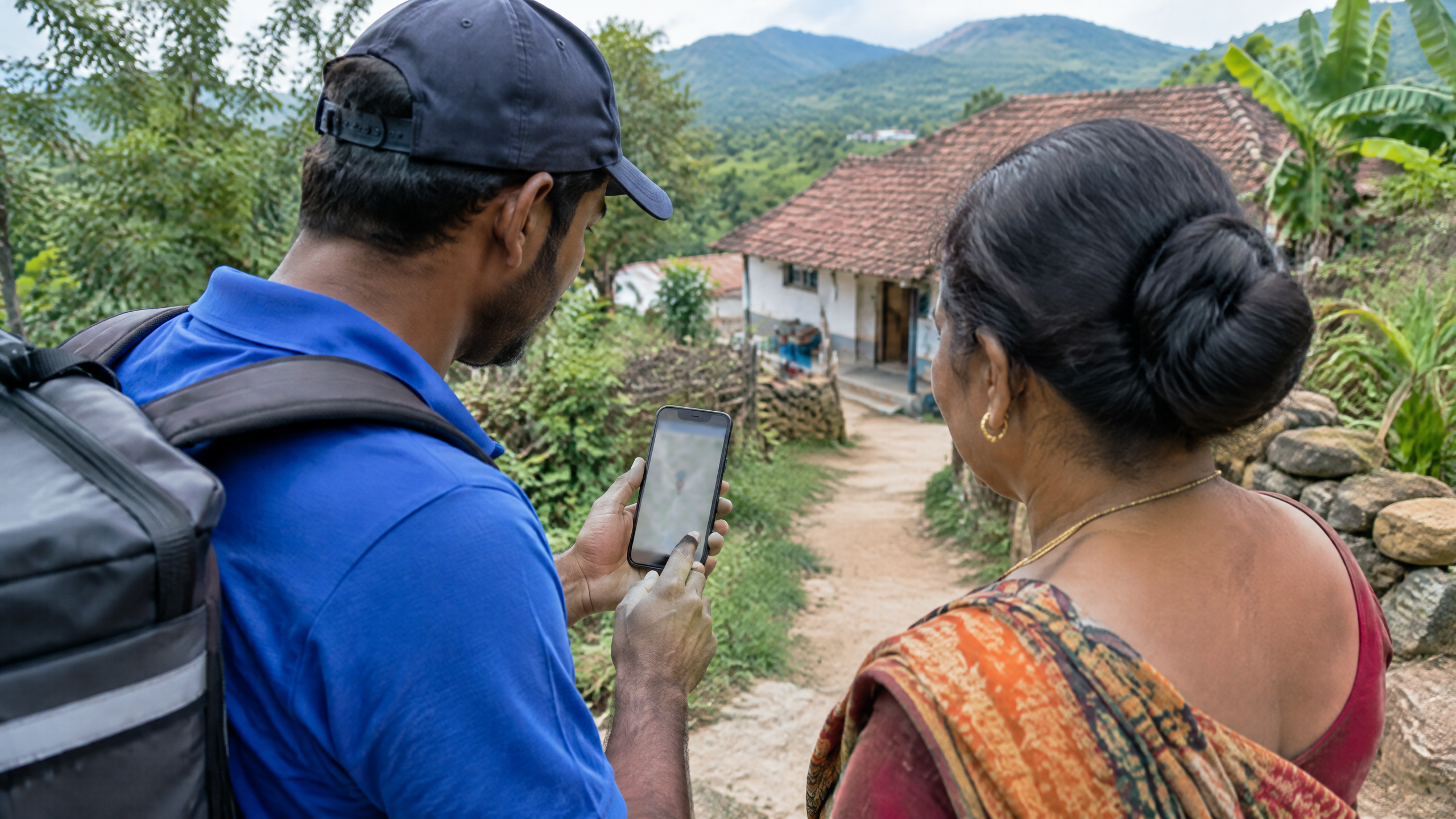
A rural home or farm entrance: A village name, landmark and PIN code may be enough for many situations, but the last turn or entrance can still be hard to describe. The location code can be shared as an additional reference if the recipient is able to use it.
A new urban layout: Street names, plot numbers and map listings can lag behind construction. A code can describe the relevant grid without depending on a settled locality name.
A building with several units: The same grid code should be paired with tower, floor and flat details. It cannot tell a visitor which unit inside the building is intended.
A site or field with no conventional street address: A code can help record a consistent point, but a recipient may still need access instructions, a nearby landmark and confirmation that it supports the code.
These are possible uses, not guarantees. A code alone does not make a courier, government agency, retailer, map app or emergency dispatcher able to route a request. Each organisation controls its own address fields, service area and operational process.
The important difference between grid size and real-world accuracy
“Approximately four metres” describes the size of a DIGIPIN grid cell. It is not a promise that every phone can determine a person’s position to four metres, that a map will guide someone to the right gate, or that a driver can identify the correct flat. India Post says the accuracy of a generated code largely depends on the precision of the GNSS-enabled device used to capture the coordinates. [1]
This is particularly important around multi-storey buildings, dense lanes, tree cover, covered areas and property boundaries. The code does not include height, entrance side or access route. Before sharing it for a visit or delivery, add practical details such as “rear gate,” a flat number, a landmark or a contact method where appropriate. Do not share more location detail than the recipient genuinely needs.
The underlying encoding can be implemented offline because the published code logic does not need a live central lookup to convert known coordinates. [1] [4] But a device may still need GNSS or another source to obtain a fresh location in the first place. Offline encoding should not be confused with an assurance that every phone, offline map or receiving service can locate or navigate to the point.
What DIGIPIN does not do
DIGIPIN is not a substitute for identity documents, a proof of residence, KYC, property ownership records, a verified digital address or a consent record. It does not contain a resident’s personal information. That is useful, but it does not remove the privacy implications of sharing a precise location with another person or service. The recipient’s own data practices still matter. [1]
It is also separate from the Department of Posts’ broader DHRUVA concept. The DHRUVA consultation document describes DIGIPIN as the open geo-coded grid layer and a distinct, proposed Digital Address layer as a consent-based system that could use human-friendly labels and descriptive address information. Do not assume that receiving a DIGIPIN gives you a Digital Address, verification label or username. [5]
For urgent or safety-critical situations, use the appropriate current local emergency channel and explain the location in the formats that service asks for. A DIGIPIN may be a useful additional detail only where the operator or system can use it; it should not be the sole plan for reaching help.
Current adoption: check the receiving service first
India Post says DIGIPIN complements conventional addressing rather than replacing it. Its current FAQ also says that a person cannot yet use DIGIPIN alone to book a postal article at a post office; the Department says it will announce when its systems have incorporated the final version. [1]
That is a helpful reality check. If an online form, delivery partner, bank, public service or local office asks for a PIN code and normal address, provide the required fields. Ask whether it accepts a DIGIPIN as an additional location reference rather than assuming that it does. Never treat a generated code as confirmation that a parcel, benefit, emergency response or appointment has been accepted.
For everyday smartphone habits around official links, permissions and sharing information from a phone, see TechDuoPulse’s smartphone security guide. DIGIPIN itself is a location system, not a cybersecurity product, but a careful approach to sharing still helps.
Frequently asked questions
### Is DIGIPIN the same as a PIN code?
No. A PIN code identifies a broader postal area. A DIGIPIN identifies an approximately four-metre-by-four-metre geographic grid. India Post describes DIGIPIN as an additional layer that complements, rather than replaces, the ordinary postal address and PIN code. [1]
### Does a DIGIPIN replace my house number or flat number?
No. The code is derived from location coordinates and does not encode floor, flat or resident information. Keep house, building, floor and flat details where a recipient needs them. [1]
### Do I need to sign up to find my DIGIPIN?
India Post says no login or sign-up is required for its official lookup service. The device needs to provide location access so the service can determine the relevant coordinates. [1] [3]
### Can I find a DIGIPIN without internet?
The published encoding logic can work offline once coordinates are known. However, obtaining a current location and using a particular lookup or navigation service can still require a device capability, connectivity or both. [1] [4]
### Can I use DIGIPIN to send a parcel from a post office today?
Not as the sole booking address. India Post’s current FAQ says post-office booking with DIGIPIN will be possible only after the Department incorporates the final version into its systems and makes an official announcement. [1]
### Does DIGIPIN reveal personal information?
The code represents a geographic location and does not itself store personal information. Still, a precise location may be sensitive in context, so share it thoughtfully and check what the recipient needs. [1]
Frequently asked questions about DIGIPIN
These short answers summarise the practical scope of this explainer. Service availability, eligibility and implementation details can change, so check the current official guidance before acting.
What is DIGIPIN?
DIGIPIN Article Package explains the purpose, user experience and practical limits of DIGIPIN in India.
Who can use DIGIPIN?
Eligibility depends on the service, the user profile and the current rules or implementation of the participating organisation.
What should users check before using it?
Check the identity, consent, privacy, eligibility and support information shown by the service. Do not share sensitive information with an unverified person or interface.
Is DIGIPIN available everywhere?
Coverage and features may vary by state, department, institution, provider, device and rollout stage. Treat availability as status-labelled rather than universal.
Source notes
Reporting record
techduopulse stores source destinations privately. Public notes remain non-clickable so every visitor journey stays on this website.
India Post: DIGIPIN
Primary source · Research source 1Digital Postal Index Number (DIGIPIN): National Level Addressing Grid — Technical Document
Primary source · Research source 2India Post Digital Address Services: Know Your DIGIPIN
Primary source · Research source 3India Post DIGIPIN source repository
Primary source · Research source 4DHRUVA: Digital Address ecosystem consultation document
Primary source · Research source 5New India-focused explainer covering DIGIPIN, user context, limitations and verified sources.