Small language models, or SLMs, are compact language models that can process and generate text with a smaller parameter footprint than much larger alternatives. They can be useful for focused tasks or resource-constrained applications. “Small” is a descriptive category rather than a universal numerical standard, and fewer parameters do not guarantee a faster, more accurate or more private application. [1]
This guide explains the difference between a smaller model and a compressed representation, reviews four documented model variants and shows how to assess memory and deployment claims. It also distinguishes a potential local-data benefit from automatic privacy. The useful choice is the model that meets the task’s quality and device constraints—not the smallest name on a list. [2] [3] [4] [5] [7]
Show less
On this page 16 sections
- Key Takeaways
- What makes a language model small?
- How compact language models learn and generate text
- Small models versus large models: compare the task, not just size
- Distillation, quantisation, pruning and fine-tuning are different tools
- Four documented compact model examples
- Small weights are only one part of the memory budget
- Can SLMs run on CPUs, phones and edge hardware?
- Local processing can help data control, but does not guarantee privacy
- Use compact models where the task can be defined and checked
- The main limits remain task quality and reliability
- What further compact-model progress should be judged against
- Important Points / Key Information
- Examples / Supporting Information
- Common questions about small language models
- Conclusion
Part of our artificial intelligence technology guide library
Key Takeaways
- A compact model can fit focused tasks and limited resources, but no universal parameter cutoff defines every SLM.
- Distillation, quantisation, pruning and fine-tuning have different roles; none guarantees unchanged accuracy.
- Use exact variant documentation for modalities, languages, context, licence and runtime support.
- Raw weight storage does not establish the full memory requirement; local inference does not guarantee privacy or an offline application.
What makes a language model small?
A parameter is a learned numerical value used by the model. Parameter count gives one indication of the scale of its learned computation and storage, but it does not describe every architectural choice, training method or runtime allocation. IBM’s explanation places SLMs broadly in the range of millions to a few billion parameters; this is a descriptive range, not a standard that every publisher uses identically. [1]
A model family may include compact and much larger variants. The family name alone therefore does not tell you the size or capability of the selected checkpoint. Labels such as mini, 1B or 3B should be read alongside the specific model card, not treated as an installation requirement.
Parameter counts also need consistent interpretation. A rounded size label, total parameters, non-embedding parameters and the parameters active in a mixture-of-experts step are different quantities. A model that activates fewer experts still has stored weights that must be accommodated. Do not compare these numbers as though they were the same measure.
How compact language models learn and generate text
Many compact generative models use decoder-only Transformers, with tokenised input and autoregressive output generation. Microsoft describes Phi-4-mini-instruct as a dense decoder-only Transformer, while Meta describes its compact Llama 3.2 models as autoregressive Transformers. Small does not mean an entirely different category of language-processing mechanism. [2] [4]
Compact models can be pretrained and post-trained, derived from a larger model, or developed using several methods together. Distillation and pruning are possible routes—not requirements that every SLM is simply a larger checkpoint cut down. Training-data quality and the learning objective also matter. [2] [4] [6]
Inference uses the resulting model to process prompts and produce outputs. Training and fine-tuning require additional work to update parameters, so a device that can run a model is not automatically capable of training it conveniently. This article is an explanation, not a model-installation or training recipe.
Small models versus large models: compare the task, not just size
A compact model can reduce raw weight storage and some per-step work, making local or lower-resource execution more feasible. That is a potential advantage, not a promise of lower end-to-end latency on every device. Kernel support, numerical precision, memory access and generated response length all affect the result.
A larger model may handle a broader set of difficult requests, while a smaller model with appropriate data or adaptation may perform well on a narrower task. Neither statement establishes a universal ranking. Compare representative inputs and failure cases rather than transferring a result from an unrelated benchmark.
Resource efficiency and answer quality should be assessed together. A fast response that misses a required field or invents a fact is not a successful extraction or support answer. Equally, a more capable model can be unnecessary for a simple, well-specified task when a compact option meets the same acceptance criteria.
Distillation, quantisation, pruning and fine-tuning are different tools
These methods can appear in one development pipeline, but they change different aspects of the model. Their benefits depend on the resulting checkpoint, accuracy and execution path. [4] [6] [7]
Knowledge distillation: train a student using teacher behaviour
Distillation uses a teacher model’s outputs or probability information as training guidance for a student. In a compact-model pipeline, the student can learn useful behaviour without retaining all of the teacher’s parameters. It is a learning process, not merely copying a large file into a smaller format. [6]
Meta’s Llama 3.2 card gives a concrete example: it describes pruning and using larger Llama-model logits during training, with knowledge distillation used to recover performance. That does not mean every teacher capability, fact or safety property is reproduced perfectly in the student. [4]
Quantisation: fewer bits do not mean fewer learned parameters
Quantisation represents selected weights or activations at lower precision. INT8 and INT4 indicate eight-bit and four-bit integer representations; formats such as FP4 or NF4 have different numerical meanings. A quantised large-parameter model does not automatically become a smaller-parameter architecture. [7]
The lower-precision representation can reduce storage, but scales, unconverted modules and other state remain. Quantisation can also introduce numerical error, and suitable kernels are needed for a speed benefit. Evaluate the exact format and task rather than assuming that four bits preserve the original behaviour. [7]
Pruning: remove or suppress selected model structure
Pruning can target weights, channels, attention heads or layers. Structured pruning changes larger parts of the model’s computation; unstructured pruning can create sparse weight patterns. Zero values alone do not prove that a dense runtime will execute less work. [1] [6]
Pruning can damage accuracy and may need further training or distillation to recover useful performance. NVIDIA’s practical discussion distinguishes depth and width pruning and their accuracy-versus-latency trade-offs. This is not evidence that removing any apparently unnecessary parameters is harmless. [6]
Fine-tuning: adapt behaviour without automatically shrinking the model
Fine-tuning adjusts a pretrained model for a task, instruction format or domain. A compact model can benefit from representative examples, but adaptation is not proof that it now has comprehensive expertise in the domain. Microsoft encourages use-case evaluation and suitable safeguards around its general-purpose Phi models. [2]
Fine-tuning does not inherently reduce parameter count; adapter-based methods can add trainable components. Distinguish task adaptation from compression, and test the adapted model on held-out examples rather than only the material used to train it.
Four documented compact model examples
These are identifiable examples whose documentation was checked on 5 November 2026. They are not a popularity ranking or a list of models launched in 2026. Family generations, context limits and licences must be tied to the exact variant.
Microsoft Phi-4-mini-instruct
Microsoft’s model card describes a 3.8-billion-parameter, text-input/text-output dense Transformer released in February 2025, with a stated 128K-token context length. Its training description includes filtered material and synthetic educational data. The card lists the MIT licence. [2]
The mini label is not proof of support on every phone. The documented language list also does not include Hindi, so this guide does not assert Hindi support for that variant. Its language and hardware suitability need model-specific evaluation rather than an assumption based on the broader Phi family. [2]
Google Gemma 3 1B
Google explicitly describes Gemma 3’s 1B variant as text-only. Its documented context limit is 32K tokens, rather than the 128K figure associated with larger Gemma 3 variants. Do not inherit image-input capability or every limit from the family’s broader description. [3] [8]
This is a version-specific example of a compact open-weight model, not a claim that Gemma 3 is the latest Gemma release in November 2026. Access and use remain subject to Gemma’s terms, and a published model card is not a universal device-performance certificate. [3]
Meta Llama 3.2 compact text models
Meta’s September 2024 release includes text-only variants labelled 1B and 3B. The card reports counts of 1.23B and 3.21B, illustrating why rounded names should not be treated as exact weight-storage calculations. It documents pruning and distillation in their development. [4]
Hindi is among the officially supported languages for these variants, but that does not prove equal quality on every Hindi, mixed-language or specialist request. The card also gives different context limits for ordinary and documented quantised variants. Use of these weights is governed by the Llama 3.2 Community License and associated conditions, not the MIT licence. [4]
Qwen3-0.6B
Qwen’s named Qwen3-0.6B variant is another compact text-model example. Its card describes thinking and non-thinking operation and lists a 32,768-token context length. The size label should not be substituted for the actual tensor allocation when planning memory. [5]
Thinking behaviour can change the amount of generated text and the time taken to finish a request. A compact model can therefore spend substantial time generating an answer; the name alone does not establish its latency. The card lists Apache 2.0, but capability and compatibility still need checks for the intended application. [5]
Small weights are only one part of the memory budget
Actual memory use includes more than the model’s stored weights. KV states for the prompt and generated sequence, activations, workspaces and runtime allocations also need room. The operating system and application need headroom too. Smaller parameters do not remove the cost of long contexts or concurrent requests.
Model variants can use different attention architectures and cache layouts. A nominal context limit states what the model or variant supports; it is not a promise that the maximum context will fit within the memory available on a particular device. [3] [4]
Check whether weights and runtime state live in system RAM, device memory or an offloaded arrangement. Those paths have different transfer and execution costs. Do not present a raw file-size estimate as a required-RAM figure.
A simple weight-storage example—not a device requirement
Consider a hypothetical dense model with exactly one billion parameters, all stored at one precision. Sixteen bits per parameter gives 2 GB of raw weights in decimal units. Eight bits gives an ideal 1 GB; four bits gives an ideal 0.5 GB.
This arithmetic excludes quantisation scales and metadata, higher-precision exceptions, KV states, temporary buffers and the rest of the software. It is not a measurement of Phi, Gemma, Llama or Qwen, and it is not evidence that a device with the same advertised memory capacity can run the model well.
The example separates two questions: how much space the ideal weight representation uses, and whether the complete application meets the device’s memory, latency and quality requirements. The second needs a real implementation test.
Can SLMs run on CPUs, phones and edge hardware?
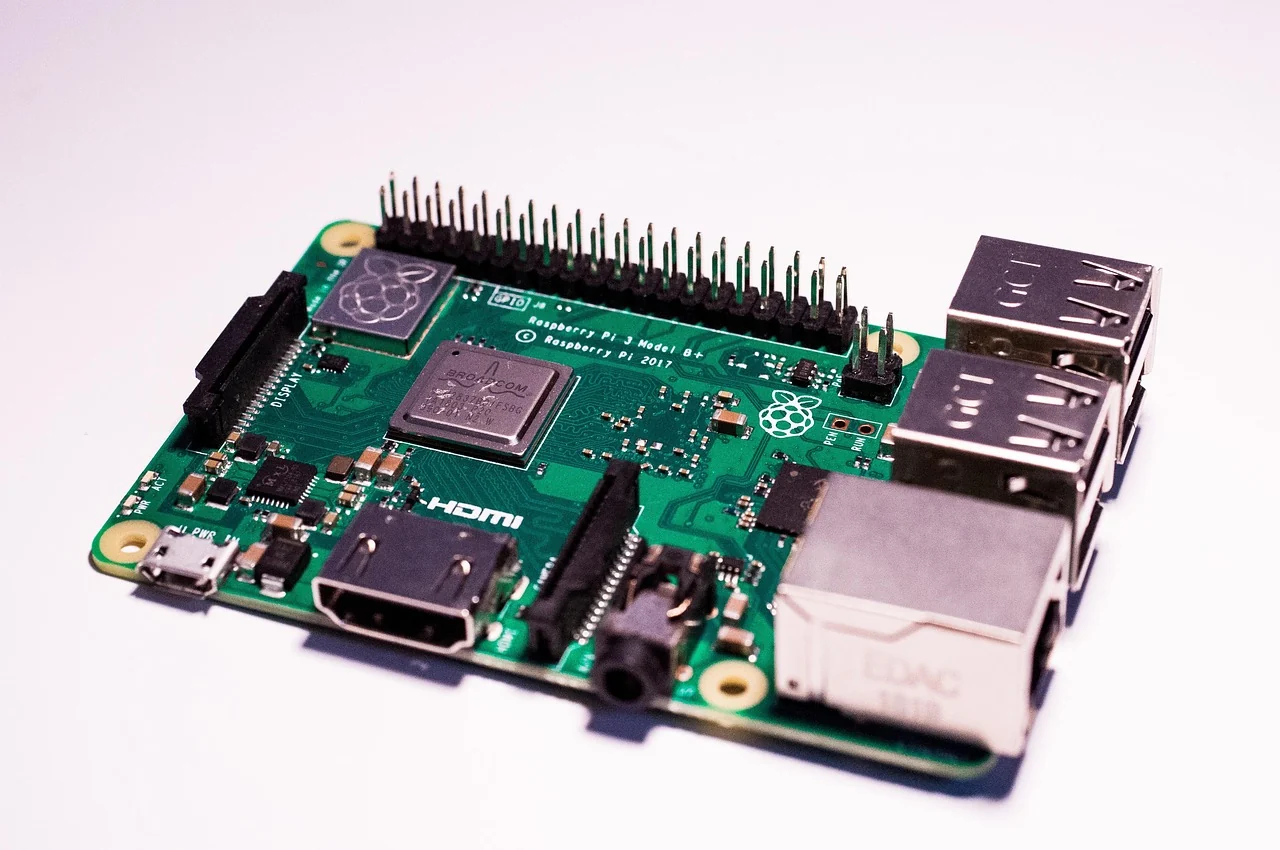
Suitable compact models can run in local-device environments, but CPU, GPU and other accelerator paths are not interchangeable. The supported runtime, operators, precision and available memory matter. The illustrated single-board computer is representative hardware only—not evidence that it runs any model named here. [3] [4] [8]
For a phone or battery-powered device, test sustained behaviour as well as one short response. Heat, available memory, background work and energy use can affect the experience. A smaller checkpoint creates an opportunity for local execution; it does not guarantee acceptable speed or battery life.
The model still needs an application around it. Tokenization, retrieval, user interaction and any tool calls may add work or depend on a network. An offline-capable inference engine does not automatically make the entire application offline.
Local processing can help data control, but does not guarantee privacy
Keeping inference on a controlled device can reduce the need to send prompts to a remote model service. However, logs, telemetry, backups, retrieval systems and other application components may still store or transmit information. Model location is only one part of the data flow.
Access controls, retention choices and secure application behaviour still matter. Downloaded weights also do not make generated statements reliable or immune to malicious inputs. A local model can produce misleading output just as a hosted model can. [1] [2]
Assess the actual application and its data paths before making an offline or private claim. No network-traffic inspection, application privacy test or hardware test was performed for this guide.
Use compact models where the task can be defined and checked
A support workflow might use a compact model to classify an incoming question or extract fields, then validate those fields before further use. A local assistant might summarise an available document when network access is limited. These are possible workflow examples, not reported deployments or performance measurements.
Where difficult reasoning or broad factual coverage is essential, a larger model or another system component may be appropriate. Routing more difficult requests can be useful, but deciding whether an answer is good enough is itself a validation problem—not something the model’s confidence guarantees.
Healthcare, legal and other consequential applications need stronger evaluation and appropriate expert oversight. A small model is not a substitute for a qualified professional or validated safety-critical system. The Phi card explicitly warns that high-risk and specialist uses need additional assessment and safeguards. [2]
The main limits remain task quality and reliability
Compact models can have less capacity for broad factual knowledge or complex requests, and can still inherit bias, hallucinate or mishandle instructions. Focused adaptation can help selected tasks without proving dependable generalisation to unfamiliar inputs. [1] [2]
For an India-facing service, test representative languages and mixed scripts rather than assuming that a multilingual family name covers the intended users. Distinguish a documented supported language from measured quality on the local task. Llama’s Hindi listing and Phi-4-mini’s different language list illustrate why variant-level checks matter. [2] [4]
What further compact-model progress should be judged against
Work on compact models includes better training data, architecture choices, compression and local execution paths. The documented pruning/distillation and Gemma attention examples show different ways to improve a smaller model’s usefulness or memory behaviour. No single method removes every constraint. [4] [6] [8]
Useful progress is not merely another small parameter label. It means the application can complete its intended tasks with acceptable quality, latency, memory and operating requirements. Future device or model releases still need those checks; this guide does not predict a universal replacement of larger models.
Important Points / Key Information
Keep the model label, its numerical representation and the application’s measured behaviour separate.
- SLM is a descriptive category; there is no universal size cutoff established by the sources used here. [1]
- Distillation trains a student, quantisation changes representation, pruning alters selected weights or structure, and fine-tuning adapts behaviour. [4] [6] [7]
- Compact family variants have different modalities, language lists, context limits and licences. [2] [3] [4] [5]
- Raw weight storage is not the complete memory requirement, and smaller does not automatically mean faster.
- Local inference can improve control over data paths, but the surrounding application determines its privacy and offline behaviour.
Examples / Supporting Information
The four named variants demonstrate why a family label is insufficient: Phi-4-mini specifies a particular language list, Gemma 3 1B is text-only, Llama 3.2 uses rounded size names and Qwen3 offers different thinking behaviour. These are documentation-backed distinctions, not a performance leaderboard. [2] [3] [4] [5]
The one-billion-parameter calculation is deliberately hypothetical. It explains ideal raw storage without turning a model-card size or device specification into a tested deployment recommendation.
Common questions about small language models
What is the difference between an SLM and an LLM?
SLM usually describes a more compact language model relative to much larger alternatives. It is not a universal architecture boundary or a guarantee of limited-purpose capability. Check the specific parameter count, training and task performance rather than relying on the label. [1]
Are small language models always faster?
No. Fewer weights can reduce resource use, but runtime support, hardware, precision, context and output length determine actual performance. Compare response latency and task quality on the intended implementation, not model names alone.
Can a small language model run on a smartphone?
Suitable variants and runtimes can support on-device use. That does not establish compatibility or acceptable sustained performance on every phone. Available memory, supported operators, heat and application dependencies must be considered. [3] [4] [8]
Do SLMs require a GPU?
Not as a universal rule. Some local execution paths use CPUs or other accelerators, while a particular runtime or attention implementation may expect compatible GPU hardware. Check the exact model and software rather than promising support based on size. [2] [4]
Are compact models safe for enterprise use?
They can be useful components in appropriately evaluated workflows, but compact size does not establish safety, privacy or accuracy. Apply access and data-flow controls, validate outputs and use suitable oversight for consequential decisions. [1] [2]
Conclusion
Small language models provide another way to match language processing to a task and its available resources. Their value comes from meeting useful quality and operating requirements with a manageable implementation—not from being smaller in name alone.
Use the exact variant’s documentation, keep compression techniques distinct and budget for the whole application. A measured comparison on representative requests is more useful than assuming that every compact model is fast, private, offline or suitable for a specialist task.
How we checked thisSources (8)
We keep source links private so your reading stays on techduopulse. Each note names the publisher and document we checked.
Hugging Face — Transformers — Quantization documentation
Primary source · Lower-precision representations and unconverted componentsIBM — What are small language models?
Primary source · SLM definition, compression approaches and limitationsMicrosoft — Phi-4-mini-instruct — model card
Primary source · Exact variant, size, training, languages, licence and risk caveatsGoogle DeepMind — Gemma 3 1B instruction-tuned — model card
Primary source · Variant context limit and model-use termsMeta — Llama 3.2 1B Instruct — model card
Primary source · Compact variant sizes, language support, distillation and licenceQwen team — Qwen3-0.6B — model card
Primary source · Named compact variant, context and thinking-mode differencesNVIDIA — LLM Model Pruning and Knowledge Distillation with NVIDIA NeMo Framework
Primary source · Structured pruning and teacher/student training trade-offsGoogle for Developers — Gemma explained: What’s new in Gemma 3
Primary source · Explicit text-only Gemma 3 1B and architecture/context distinctionsInitial source-backed manual publication. Existing reviewed article facts and original licensed real photograph preserved. Full article remains server-rendered, keyboard accessible and printable behind a two-paragraph reading disclosure.