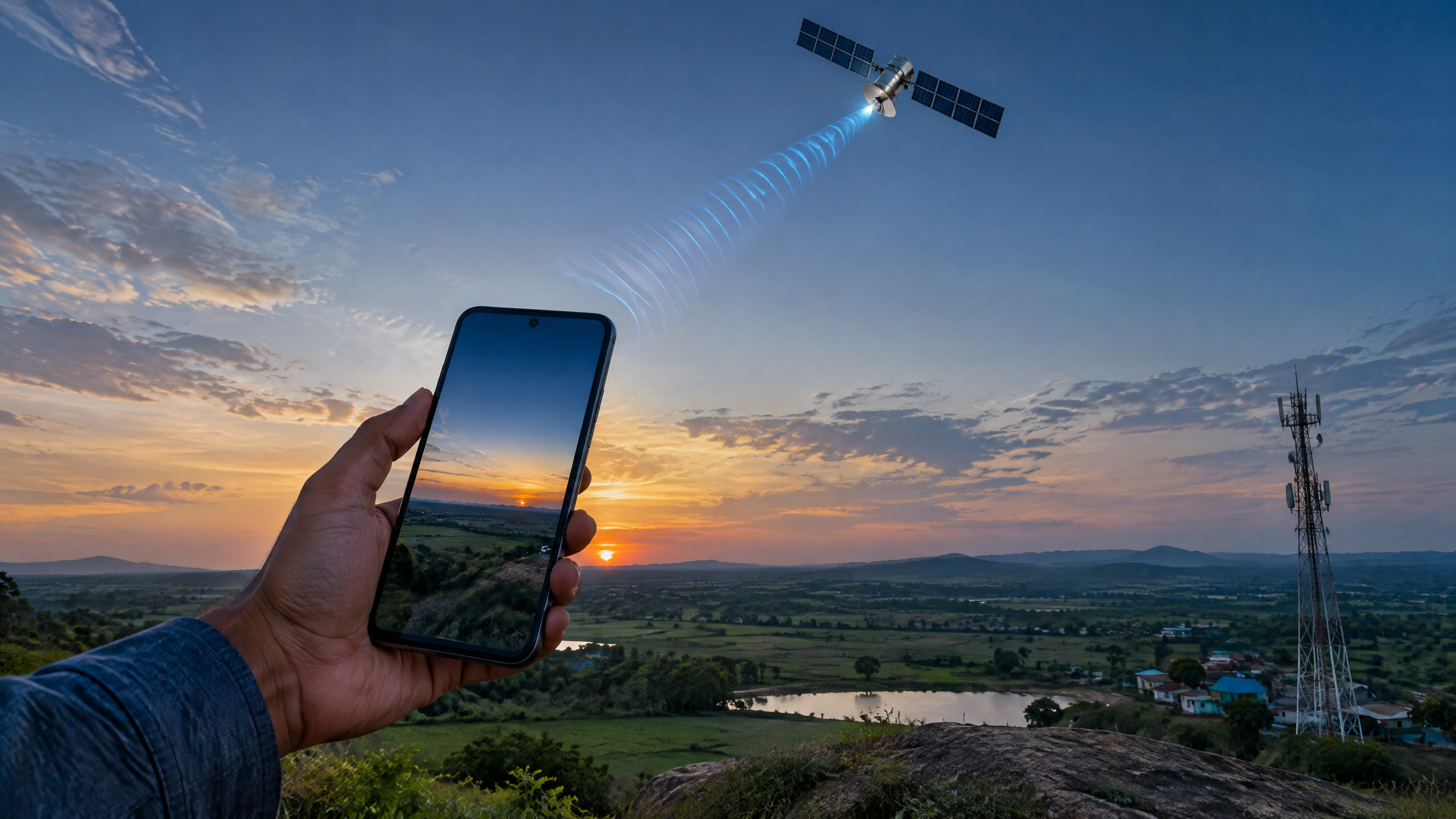
A phone that can send a message when it is beyond a mobile tower is a compelling idea. But satellite internet in India is not one thing. It can mean a broadband connection using a dish, a satellite link that backhauls traffic for a remote cell site, or a direct-to-device (D2D) link between a satellite and a compatible phone. Those systems share some space technology, yet they make very different compromises in antenna size, capacity, coverage, latency, spectrum and regulation. The useful way to understand the subject is to start with the route a signal takes. A satellite network still needs ground infrastructure, licensed radio spectrum, compatible devices and a link into an operator or internet network. The satellite extends a network into places where terrestrial infrastructure is difficult or uneconomic; it does not make those other components disappear.
This article is part of the software engineering technologies guide library.
Key takeaways
Non-terrestrial network (NTN) is a broad 3GPP term for a network segment that uses a satellite or airborne platform carrying relay or base-station functions. It is broader than consumer satellite internet. [1]
Direct-to-device is usually a coverage-complement tool, not an automatic replacement for terrestrial mobile broadband. A small phone antenna, shared satellite capacity and the radio link constrain what it can do. [1] [4]
A standards label is not a service promise. 3GPP Release 17 includes NR-over-NTN and IoT-over-NTN work, but a usable service also needs compatible handset hardware/software, spectrum, network integration and local approvals. [2] [3]
Orbit is a trade-off. Lower-orbit satellites reduce distance to the user but move relative to Earth, requiring a constellation and handover. A geostationary satellite appears fixed but is much farther away. [1]
India’s policy and ecosystem discussion is active but date-sensitive. As of the sources checked on 13 October 2026, India Mobile Congress lists Satcom/D2D/NTN as a technology topic, and DoT and TRAI materials show technical and framework work. That is not evidence that any particular consumer service is available at a particular location. [5] [6] [7]
What are satellite internet, NTN and direct-to-device?
Satellite internet is the broadest everyday term. It describes internet access where part of the route uses a satellite radio link. The customer might use a fixed terminal with a dish, a vehicle-mounted antenna, a compact IoT device or, in some designs, an ordinary-looking mobile handset.
Non-terrestrial network (NTN) is a standards and network-architecture term. 3GPP defines it as a network, or part of a network, that uses an airborne or space-borne vehicle carrying transmission relay-node or base-station equipment. That can include satellites as well as high-altitude platforms. [1]
Direct-to-device (D2D) or direct-to-cell describes the access side of the connection: the user device communicates with a satellite without a separate customer dish. The target device may be a phone, tracker, sensor or another cellular-style device. D2D is therefore one possible kind of NTN service, not a synonym for every satellite connection.
Plain-English definition: A direct-to-device satellite network tries to put a cellular-like radio link between a compatible device and a satellite, then carries that traffic through gateways and network systems on the ground.
### Three satellite connectivity models that are easy to confuse
| Model | What connects to the satellite? | Typical role | What it does not imply |
|---|---|---|---|
| Fixed satellite broadband | A dedicated user terminal or dish | Internet for a home, site, vehicle or business | That a regular phone can connect directly |
| Satellite backhaul | A cell tower, Wi-Fi site, enterprise site or network hub | Extending a terrestrial network where fibre or microwave is difficult | That the end user is talking to the satellite |
| Direct-to-device / direct-to-cell | A compatible phone or IoT device | Basic coverage extension, messaging, IoT or other service designed for the link | That every phone, app, location or data service will work |
This distinction matters in coverage claims. A village can have mobile service delivered by a terrestrial tower whose backhaul uses a satellite, while users’ phones never connect to space. Conversely, a D2D device can see a satellite while the service is limited to a narrow set of functions. Ask which radio link is satellite-based, which device is used and what service is actually supported.
How a direct-to-device NTN network works
A simplified D2D path looks like this:
The device finds and connects to an NTN signal. The handset or IoT device uses compatible radio hardware, supported frequencies and network software. In 3GPP’s initial NR NTN solution, terminals were assumed to have GNSS capability because position and satellite data help manage timing and Doppler effects. [1]
The satellite relays or processes the signal. In a transparent, or “bent-pipe”, design, the satellite mainly receives, filters, changes frequency, amplifies and retransmits the radio signal. In a regenerative design, it also performs digital processing and can host some base-station functions. [1]
A gateway receives the feeder link. An NTN gateway is an earth station that connects the satellite payload to the terrestrial network through a feeder link. [1]
The core network routes the traffic. Depending on the service, the traffic can reach an operator core network, emergency system, enterprise platform, internet service or another device.
The response follows the reverse path. The gateway, satellite and device must all be reachable for a two-way service. Network design also has to handle movement between satellite beams or satellites.
This is still a network, not a single sky-to-phone hop. A satellite may be visible to a user while a gateway, feeder link, core network, roaming arrangement or service platform is unavailable. The practical reliability of the end-to-end service depends on all of those parts.
### Why timing and movement make NTN different from an ordinary tower
A terrestrial mobile tower is comparatively close and stationary relative to the phone. A satellite can be hundreds or thousands of kilometres away and may move rapidly across the user’s sky. The radio signal has a longer path, and a low-Earth-orbit (LEO) satellite’s motion changes the apparent radio frequency through Doppler shift.
3GPP’s NTN work includes mechanisms for timing advance and Doppler pre-compensation. In the Release 17 assumptions described by 3GPP, the device uses its position, satellite ephemeris and timing information before connecting. [1] This is why “uses cellular standards” should not be read as “works exactly like a nearby terrestrial cell.”
The satellite architecture: orbit, payload and ground network
The architecture determines many of the outcomes readers care about: delay, coverage pattern, handover, equipment design and capacity planning.
### LEO, MEO and GEO: distance changes the compromise
3GPP’s overview describes typical LEO altitudes of 500–2,000 km, MEO altitudes of 8,000–20,000 km, and geostationary orbit (GEO) at 35,786 km above the equator. [1]
LEO: A lower path length can help reduce propagation delay and improve the link budget. The trade-off is that satellites move relative to the ground, so a service needs a constellation and handovers to maintain continuity. [1]
MEO: Sits between LEO and GEO in altitude, with its own balance of coverage and delay.
GEO: Appears fixed to an observer on the ground, which simplifies pointing for some applications. Its much greater distance means the radio path adds more propagation delay than a lower-orbit system. [1]
The conclusion is not that one orbit is universally better. A fixed terminal with a directional antenna and a phone with a small integrated antenna are different engineering problems. A provider’s spectrum, payload, gateway geography, device design and service target matter alongside orbit.
### Transparent versus regenerative payloads
A transparent payload acts like a sophisticated radio repeater in space. Most signal processing and base-station functions remain on the ground. A regenerative payload adds digital processing on the platform, which can include demodulation, routing, coding or base-station functions. [1]
This difference can affect where functions are placed, how a network is designed and how it handles a feeder-link change. It does not, by itself, tell a reader whether a service is faster, cheaper or available locally. Those are implementation-specific outcomes.
### The antenna problem: why a phone link is hard
A fixed broadband terminal can use an antenna purpose-built for satellite communication. A smartphone must work within tight limits on antenna size, transmit power, battery use and heat, while also supporting normal cellular, Wi-Fi and Bluetooth functions.
That makes a D2D link technically demanding. A network may compensate using satellite antenna design, spectrum choices, beam management, coding, repeated transmission opportunities and device/network integration. But the fundamental radio trade-off remains: a small handheld device communicating over a long path has less margin than a large, well-aimed fixed terminal. This is an engineering interpretation of the architecture; actual performance must be verified against the specific device, plan and conditions.
Coverage, capacity and latency: what satellite can and cannot solve
Satellites can add reach where terrain, distance, disaster damage or deployment cost makes terrestrial coverage hard. They can also support resilience by creating a path that is physically different from a local fibre or tower route. India’s DoT described D2D as a potential complement to terrestrial networks for geographically challenging areas and disaster preparedness at an April 2026 technical workshop. [6]
That potential should not be confused with unlimited capacity or guaranteed connectivity.
### Coverage is not the same as service quality
A footprint or a coverage map can mean that a beam reaches an area. It does not confirm that a given device is supported, that the network has capacity at that moment, that the user has a clear view of the satellite, or that a local service arrangement has been enabled.
For a handheld D2D service, buildings, terrain, trees, the phone’s orientation and the satellite’s elevation can matter. A clear-sky condition can be more favourable than a location inside a building, below a dense canopy or in a narrow valley. The exact behaviour belongs in device and service documentation, not in an assumption based only on the word “satellite.”
### Capacity is shared, so priority matters
A satellite beam serves an area with finite radio resources. A service designed for short messages, device check-ins or modest telemetry has different capacity needs from one designed for video, large downloads or many simultaneous users. As a result, providers may limit data types, message size, session duration, supported apps or the number of active devices.
This is why a direct-to-device feature can be useful without being a replacement for regular 4G or 5G broadband. It may be the right tool for a location update, a text, an emergency request or a narrow IoT task. It is not sensible to infer full terrestrial-network capacity from the fact that a handset can connect at all.
### Latency has more than one component
Latency is the time between sending data and receiving a response. Satellite distance adds propagation delay, but it is not the only factor. Delay can also come from device acquisition, satellite scheduling, retransmissions, gateway routing, congestion, the application server and any store-and-forward design.
The broad rule is sound: shorter space paths generally reduce the propagation part of delay, while the complete user experience depends on the end-to-end system. Avoid treating a headline number for one network or test as a universal property of “satellite internet.”
Why spectrum and standards matter
Satellite links are radio services, so they require carefully managed spectrum. In India, the National Frequency Allocation Plan 2025 says the plan governs spectrum use but does not by itself grant a right to use spectrum; a frequency assignment from the Wireless Planning and Coordination (WPC) Wing is required unless an exemption applies. [8]
That distinction is important. A frequency-band allocation, a standards specification, a satellite launch, a device demonstration and a commercial retail service are different milestones. They should not be treated as interchangeable evidence.
### 3GPP NTN helps interoperability, but it does not make every phone compatible
3GPP Release 17 lists both NR over NTN and IoT over NTN among its completed 5G projects. [2] Later 3GPP work described continued improvements, including terminal optimisation, uplink-capacity work and support for regenerative-payload architecture. [3]
Standards make it possible for chip makers, device makers, satellite operators and mobile operators to work toward interoperable systems. A particular phone still needs the required modem capability, bands, antenna/RF design, software, certification and carrier or service support. It may also need a subscribed service and a supported location.
A useful buying rule: “NTN-capable” is not a guarantee of satellite service where you are. Check the exact handset model, software version, carrier/service partner, supported country or region, permitted use cases and current terms.
### Two spectrum approaches can lead to different D2D experiences
The ITU’s March 2026 overview describes D2D approaches that use mobile-satellite-service spectrum and others that work with terrestrial mobile spectrum through operator partnerships. [4] These are not merely business-label differences. Spectrum choice can shape radio design, device support, regulatory treatment and the relationship with a mobile network.
For a reader, the safe conclusion is simple: do not assume all direct-to-device systems are technically or commercially alike. Ask which operator or network model is involved and what is explicitly supported.
Satellite internet in India: current context without availability claims
Observed, date-sensitive context (checked 13 October 2026): India Mobile Congress 2026 places “Satcom / D2D / NTN” in its agenda alongside digital-infrastructure scaling, and lists a Satcom Summit. This is evidence that the topic is on a major Indian telecom forum’s agenda; it does not measure demand, prove coverage or establish availability of a provider’s service. [5]
Observed, date-sensitive context (8 April 2026): The Department of Telecommunications’ Telecommunication Engineering Centre held a workshop on D2D technology, global precedent and the Indian context. The official release says discussions covered potential benefits, operational considerations and the enabling regulatory framework, and describes D2D as complementary to terrestrial networks. [6]
Observed, date-sensitive context: TRAI issued a consultation paper on 8 April 2026 concerning a framework for Satellite Communication Network authorisation and spectrum assignment. A consultation paper presents questions and seeks stakeholder input; it should not be read as final authorisation for a consumer offering. [7]
India’s DoT eServices portal says WPC grants frequency assignments for various satellite-based networks and lists services such as Mobile Satellite Service (MSS) and VSAT. The portal was retrieved on 13 October 2026 and may change. [9] Separately, IN-SPACe procedures describe authorisation paths for satellites or constellations intended to provide communication capacity in Indian territory and note that other government approvals can apply to gateway/hub operations. [10]
Interpretation: Satellite and NTN can be relevant to India’s diverse geography and connectivity needs, particularly as a complement for remote routes, temporary sites, maritime or mobility use cases, narrow IoT tasks and resilience planning. Whether a specific use case is practical depends on the radio link, terminal, total capacity, gateway design, commercial arrangement, permissions and the fallback available when the satellite path is not usable. This is a technology explanation, not legal, regulatory or availability advice.
Limitations and trade-offs to understand before relying on a satellite link
A good satellite design begins with the failure modes, not the marketing label.
### Device and service compatibility
The network may support only selected device models, chipsets, operating-system versions, bands or service profiles. A compatible radio modem does not guarantee that a provider has enabled every app, data service or geography. Confirm the exact combination before relying on it for travel, field work or safety planning.
### Obstructions and acquisition time
A satellite signal can be blocked or weakened by the surrounding environment. A device may also need time to identify a satellite, obtain timing information and establish a usable connection. Do not assume a link will behave like a nearby indoor cellular signal.
### Shared capacity and constrained data use
Long-range device links have finite resources. A service may be deliberately designed around messages, check-ins, telemetry or other small payloads. During concentrated demand, available capacity and delivery time can be different from normal conditions.
### Power, heat and battery cost
Searching for a satellite and transmitting over a long radio path can affect battery behaviour. Device makers decide how and when a handset exposes such features, and conditions can change the energy cost. For a mission-critical workflow, test the intended device rather than extrapolating from a product announcement.
### Ground dependencies and single points of failure
The system still relies on gateways, terrestrial backhaul, core-network functions, power and service platforms. Satellite diversity can improve resilience only when those ground components and operational procedures are designed with the same care.
### Regulation and cross-border operation
Spectrum and telecom rules are national and can evolve. A device feature enabled in one place should not be presumed permitted, supported or commercially offered in another. For India-specific operational decisions, rely on the relevant provider, operator and official authority—not a general explainer.
How to assess a satellite or D2D claim
When evaluating a phone feature, news report or provider announcement, use a short checklist:
What is the device-to-network path? Is the phone connecting directly to a satellite, or is a satellite backhauling a normal tower?
What service is named? Emergency messaging, text, voice, data, IoT telemetry and fixed broadband are not equivalent.
Which exact hardware is supported? Look for the handset model, modem/band support, software version and any required orientation or clear-sky condition.
Where is it supported? Look for an explicit, current country and area statement rather than a global footprint graphic.
What happens under load or an obstruction? Check message delivery expectations, capacity limits, retries and failure behaviour.
Which ground-network partner and permissions are involved? This helps distinguish a demonstration from an operational service.
What is the fallback? Retain terrestrial, Wi-Fi, radio, offline maps or other appropriate alternatives for consequential activities.
The goal is not to dismiss satellite technology. It is to match the tool to the requirement. A resilient, narrow messaging path can be very valuable even when it is not designed for streaming video.
Frequently asked questions
### What is a non-terrestrial network (NTN)?
An NTN is a network or network segment that uses a satellite or airborne platform carrying a transmission relay node or base-station capability. The term can cover satellite and high-altitude-platform systems, so it is broader than consumer satellite internet. [1]
### Is direct-to-device the same as satellite internet?
No. Direct-to-device describes a satellite link to a compatible phone or other endpoint without a separate user dish. Satellite internet also includes fixed-terminal broadband and satellite backhaul. The supported applications, capacity and equipment can be very different.
### Can every smartphone connect to a satellite?
No. Compatibility depends on the exact handset hardware, supported radio bands, antenna and power design, software, service partner and location. A 3GPP NTN standard does not make every existing phone capable or automatically enrolled in a service. [1] [2]
### Does D2D satellite service replace mobile towers?
Usually, it is better understood as a complement. Terrestrial networks remain efficient for dense, high-capacity mobile service. D2D can help extend a limited service into coverage gaps or support specific resilience and IoT scenarios. India’s DoT has described D2D as complementary to terrestrial networks. [6]
### What is the difference between LEO and GEO satellites for connectivity?
LEO satellites are much closer to Earth and move across the sky, so systems need constellations and handovers for continuity. GEO satellites appear fixed from the ground but are far farther away. Those differences affect propagation delay, coverage design and terminal engineering. [1]
### Is satellite internet always slower than terrestrial internet?
Not in every respect, and “slower” can mean several things. Satellite distance adds propagation delay, especially for higher orbits, but user experience also depends on capacity, congestion, gateway routing, radio conditions and the application. Fixed broadband, satellite backhaul and phone D2D links should not be compared as if they were one service category.
### Is satellite internet available everywhere in India?
Do not assume so. Availability depends on the provider, service type, exact location, terminal or handset, spectrum and authorisation status, network partnerships and current commercial terms. This article makes no provider-availability claim; verify current official service information before purchase or travel.
### Can a direct-to-device satellite link work indoors?
It may not. Buildings, terrain, trees and the device’s view of the sky can affect a satellite radio link. Follow the device/service instructions and do not rely on an indoor assumption for an emergency or remote-work plan.
### Will satellite connectivity work during a disaster?
It can be a valuable part of resilience planning, but it is not a guarantee. The device needs a usable radio path, the satellite and gateway network must be functioning, and the service must be available to the user. Keep appropriate local emergency procedures and independent fallback methods.
Same-site internal-link recommendations
Add these links only when the target page exists and its final canonical URL is confirmed:
How 5G networks work and why coverage differs → /article/5g-technology-explained
6G, intelligent RAN and India’s network roadmap → /article/6g-technology-intelligent-ran-india
Edge AI and local processing when connectivity is intermittent → /article/edge-ai-on-device-cloud-comparison
AI infrastructure and the networks behind modern computing → /article/ai-infrastructure-gpus-tpus-npus-inference-energy
AI security platforms and resilient connected systems → /article/ai-security-platforms-model-prompt-agent-protection
Quantum communication: capabilities and real limits → /article/quantum-communication-qkd-post-quantum-security
Frequently asked questions about Satellite Internet in India and NTN Explained: How Direct-to-Device Networks Work
These answers summarise the scope of this explainer. Availability, standards and implementation details can change, so check current official guidance before acting.
What is Satellite Internet in India and NTN Explained: How Direct-to-Device Networks Work?
Satellite Internet in India and NTN Explained: How Direct-to-Device Networks Work explains the main ideas, practical uses and limitations in plain English.
Why does this technology matter?
Its value depends on the problem, implementation, evidence, cost, security and the people responsible for using it.
What should readers verify?
Verify current availability, compatibility, security, privacy and regulatory details with the relevant official source.
Is this article professional or legal advice?
No. It is general technology information and does not replace professional, legal, regulatory or security advice.
Source notes
Reporting record
techduopulse stores source destinations privately. Public notes remain non-clickable so every visitor journey stays on this website.
3GPP, “Non-Terrestrial Networks (NTN)” — definitions; orbit ranges; transparent versus regenerative payloads; Release 17 assumptions; timing and Doppler mechanisms.
Primary source · Research source 13GPP, “Release 17” — lists NR over NTN and IoT over NTN among Release 17 projects.
Primary source · Research source 23GPP, “5G Non-Terrestrial Networks” (25 January 2024) — Rel-17/18 NTN work and Rel-19 improvement areas.
Primary source · Research source 3International Telecommunication Union, “Direct-to-device satellites: Four ways to connect the world” (16 March 2026) — contrasting D2D architectures, spectrum approaches and national-regulatory importance.
Primary source · Research source 4India Mobile Congress 2026, official agenda — lists Satcom / D2D / NTN and Satcom Summit as programme topics. Time-sensitive context only.
Primary source · Research source 5Press Information Bureau, Ministry of Communications, “TEC explores ‘Connectivity for All’ Vision through Deliberations on Direct-to-Device (D2D) Technologies” (8 April 2026) — official workshop and DoT framing of D2D as a complement to terrestrial networks.
Primary source · Research source 6Telecom Regulatory Authority of India, “Consultation Paper on the Framework for Satellite Communication Network Authorisation, and Assignment of Spectrum to Satellite Communication Network Providers” (8 April 2026) — consultation status and scope; not final-rule evidence.
Primary source · Research source 7Department of Telecommunications, “National Frequency Allocation Plan 2025” — allocation does not itself grant a right to use spectrum; WPC assignment context.
Primary source · Research source 8Department of Telecommunications eServices, “Satellite License” — WPC frequency-assignment role and listed service categories. Retrieved 13 October 2026; page content is date-sensitive.
Primary source · Research source 9IN-SPACe, “Norms, Guidelines and Procedures for Implementation of Indian Space Policy 2023” — high-level authorisation context for satellite/constellation capacity and related ground-system distinctions. This is not legal advice.
Primary source · Research source 10New India-focused explainer covering satellite internet in India, practical context, limitations and verified sources.