Private draft — not for publication or deployment. - SEO title: AI for Scientific Discovery: What It Can and Cannot Do - Meta description: AI for scientific discovery can speed up predictions, simulations and experiments. Learn where it helps, where it fails and why validation matters.
This article is part of the software engineering technologies guide library.
Key takeaways
AI is strongest as a search, prediction and prioritisation tool. It can make large candidate spaces manageable and help researchers decide what to test next.
Prediction is not proof. Experimental measurement, independent replication and domain review remain necessary, especially when a result will guide a high-stakes decision.
Autonomous laboratories are closed-loop systems, not magic laboratories. They combine models, instruments, robotics and pre-set decision rules; their scope is defined by their data, equipment and safety limits.
Good scientific AI requires traceability. Teams need to record datasets, model versions, code, software, hardware, evaluation choices and experimental conditions.
India’s opportunity is broader than training models. Useful AI for science also needs research compute, high-quality domain data, instruments, reproducible workflows and scientists and engineers who can validate results.
Where AI fits in the scientific and engineering workflow
Scientific work usually moves through a loop: define a problem, develop a hypothesis or design, test it, interpret the result and revise the next step. Machine learning can contribute at several points in that loop.
For example, a model can estimate a material property from a proposed crystal structure, rank protein–molecule interactions, detect a pattern in microscopy images or act as a faster approximation to a costly simulation. A researcher can then send the most promising or most uncertain candidates to detailed simulation, bench testing or a pilot system. This is more useful than asking a general-purpose chatbot to “discover something new.”
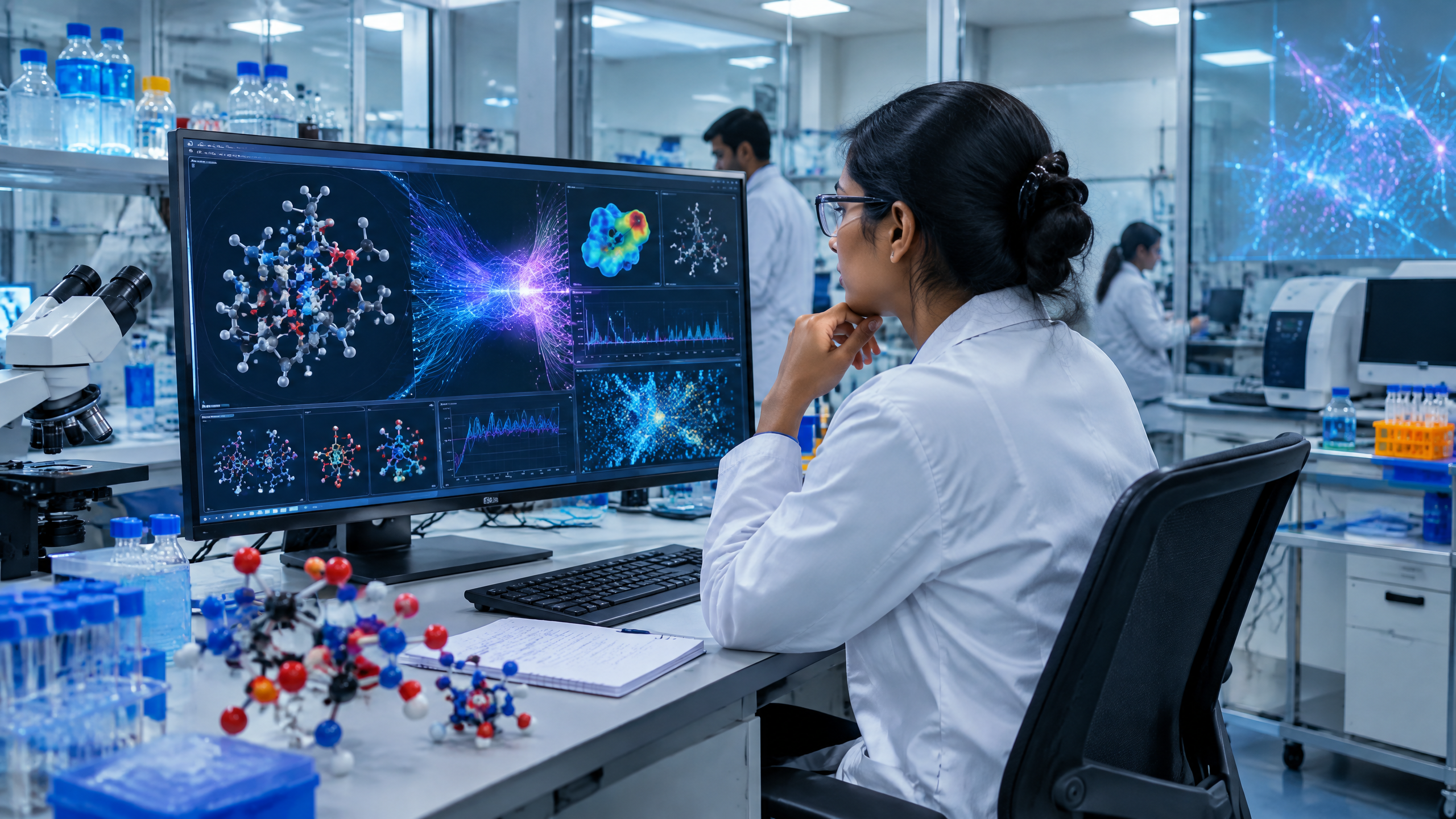
In an autonomous laboratory, software selects an experiment, instruments or robotics execute it, data analysis evaluates the result and an optimisation method proposes the next experiment. Argonne National Laboratory describes this approach as bringing together robotics, machine learning and AI while leaving scientists to interpret and act on the most interesting results. [4] The practical value comes from the closed feedback loop, not from removing people from scientific responsibility.
### Three roles that are easy to confuse
Prediction estimates an outcome from patterns in data or physical representations. A model might predict whether a candidate compound is likely to be stable.
Generation proposes new candidates, such as molecular structures, material compositions or design parameters. It expands the options that an expert may investigate; it does not show that any option will work.
Control and optimisation chooses a next measurement or experiment to improve a stated objective, such as yield, energy efficiency or uncertainty reduction. This role can connect software to laboratory or engineering equipment, so guardrails and human review matter more.
What AI for scientific discovery can do today
### Explore enormous candidate spaces
Many research and engineering problems have too many possible combinations for people to inspect one by one. AI can rank candidates before expensive simulation or experiments. In a 2023 Nature study of materials discovery, researchers reported 2.2 million structures below the calculated convex hull and stated that 736 of the predicted structures had already been independently experimentally realised. [2]
That is an important demonstration of screening at scale, not evidence that every predicted material is ready for a product. Calculated stability is a useful filter, while synthesis, properties, safety, cost and manufacturability are separate questions.
### Improve molecular and biological modelling
AI can help represent complex molecular systems. The AlphaFold 3 paper describes a diffusion-based model that predicts joint structures of complexes involving proteins, nucleic acids, small molecules, ions and modified residues, with performance comparisons against earlier specialised tools. [1]
For researchers, such a result can make hypotheses about molecular interactions quicker to formulate and prioritise. It does not replace experimental methods that determine whether an interaction occurs in the relevant biological setting, at a meaningful strength and with the intended effect.
### Connect computation, robotics and measurement
A laboratory can use AI to propose a synthesis route, run it with robotics, measure the product and alter the next attempt based on the outcome. The A-Lab materials-synthesis study reported that, over 17 days of continuous operation, the system synthesised 36 compounds from 57 selected targets. Its workflow combined computational databases, literature-derived information, machine learning, active learning, robotics and X-ray diffraction. [3]
This is a concrete example of AI laboratory automation narrowing the gap between computational suggestions and physical tests. It is also a bounded result: the work selected air-stable targets and used a specified laboratory setup. Performance cannot simply be assumed to transfer to every chemistry problem or laboratory.
### Make engineering analysis more iterative
In engineering, AI can serve as a surrogate model: a faster estimator trained to approximate the output of a more costly simulation or test. Teams can use it to explore design options, detect anomalous sensor readings, estimate a component’s behaviour or decide which simulation to run in greater detail.
The engineering benefit is often fewer unproductive iterations, not an automatic final design. A structural, electrical, chemical or safety-critical design still needs the applicable calculations, tests, tolerances and approvals. A fast approximation is valuable only when its error is measured for the operating conditions that matter.
What it cannot do — and the trade-offs to understand
### It cannot turn correlation into a causal explanation by itself
A model can find relationships in historical data without identifying the mechanism that caused them. A high prediction score may be useful, but it is not the same as an explanation of why a material performs well or why a biological system changes. Researchers must decide whether a model’s behaviour is consistent with domain knowledge and whether an intervention or controlled experiment supports the proposed mechanism.
### It cannot reliably answer questions outside its evidence
Models learn from data, assumptions and representations. If a new material, climate condition, patient population, geometry or manufacturing process differs from those foundations, output quality can fall sharply. This is often called an out-of-distribution problem. The relevant response is not blind trust or blanket rejection; it is to test on representative, held-out and, where possible, independent data before using a result to guide action.
### It cannot make poor data complete or unbiased
Scientific data can contain missing conditions, inconsistent labels, instrument drift, publication bias or narrow samples. Training on more of the same data may reproduce these limitations at scale. The OECD notes that reproducibility in AI depends on more than shared code: documentation must also specify data, ancillary software and hardware. It identifies study-design, algorithmic, implementation and observation factors as potential sources of irreproducibility. [5]
### A generative model can fabricate a persuasive answer
Large language models are useful for drafting, coding assistance and literature navigation, but they can produce confident false statements, reasoning or citations. NIST calls this risk confabulation and recommends assessing output against known ground truth, using multiple evaluation methods and documenting scientific-integrity considerations such as experimental design, data collection and construct validation. [6]
For scientific work, never treat an AI-generated citation, numerical claim, protocol or safety instruction as verified until it is checked against the original source and appropriate expert practice.
### It does not remove physical, ethical or environmental constraints
An output may be technically interesting yet unsuitable because of hazardous inputs, scarce materials, energy use, privacy concerns or unequal access to its benefits. UNESCO’s AI ethics recommendation emphasises safety and security, responsibility and accountability, transparency and explainability, human oversight, and sustainability. [8] These considerations belong in the research and engineering process, not as a last-minute checklist.
A validation-first way to use AI research tools
A trustworthy workflow treats the model as one component of an evidence chain.
State the decision clearly. Define what will be predicted or optimised, the acceptable error, the comparison baseline and the real-world constraints.
Assess data fitness. Record where data came from, what populations or conditions they represent, preprocessing choices and known gaps.
Test before deployment. Use held-out data and realistic benchmarks. For consequential work, compare with independent measurements or tests rather than only a model-created score.
Measure uncertainty and failure modes. Identify cases where the system should defer to a specialist or request more data. A ranked candidate list should retain uncertainty, not hide it.
Validate in the relevant physical or operational setting. A simulation or model prediction can justify a next experiment; it does not eliminate that experiment.
Make the work reproducible. Preserve data versions, code, prompts where relevant, model and parameter versions, random seeds, software libraries, hardware details, evaluation protocol and lab records. Independent researchers should be able to assess whether the same conclusion holds. [5]
Keep accountable people in the loop. Domain experts should review design choices and evidence, with clear authority to override the system. NIST’s AI RMF is voluntary guidance intended to incorporate trustworthiness into AI design, development, use and evaluation. [7]
India context: capability means compute plus scientific infrastructure
Date-sensitive context — checked 13 October 2026: the Office of the Principal Scientific Adviser says the Cabinet approved the India AI Mission on 7 March 2024. The official overview lists goals including access to computational resources, higher-quality non-personal datasets, indigenous AI capabilities, talent development and safe and trusted AI. It also describes a compute-capacity initiative aimed at establishing infrastructure with over 38,000 GPUs through public-private partnerships. [9]
For AI in engineering and science, compute access can help researchers train or run models and analyse large datasets. But it is only one part of the system. Progress also depends on calibrated instruments, accessible domain data, high-performance simulation, laboratory automation where it fits the problem, secure research environments and trained teams able to reproduce and challenge model outputs.
This suggests a practical India-first question for any proposed AI research project: what is the bottleneck? If testing capacity is scarce, a model that prioritises a small number of high-value experiments may be more useful than a larger model that produces an unverified catalogue. If local data are incomplete, investment in measurement standards and data stewardship may matter as much as model selection. These are editorial interpretations, not forecasts.
Observed facts versus interpretation
Observed facts: peer-reviewed work has documented AI systems that model biomolecular complexes, screen large materials spaces and connect model suggestions to robotic materials synthesis. [1] [2] [3] Official frameworks also identify reliability, scientific integrity, transparency, human oversight and reproducibility as important considerations for AI use. [5] [6] [7] [8]
Interpretation: AI is most likely to improve scientific and engineering work when it is deployed as a well-instrumented, validation-first accelerator. Its value should be measured by better decisions, reproducible findings and validated outcomes—not by the number of generated candidates or the fluency of a model’s response.
FAQs
What is AI for scientific discovery?
It is the use of AI methods to analyse scientific data, predict properties, generate research candidates, select experiments or help automate parts of a research workflow. Its output is usually a hypothesis, estimate, ranking or next action—not a finished scientific fact.
Can AI make a scientific discovery on its own?
AI can generate useful candidates and, in an autonomous lab, can help run a defined experimental loop. Yet a discovery claim still needs appropriate evidence, validation and human accountability. The system’s autonomy is limited by the goals, data, instruments and rules that people provide.
Is AI in engineering the same as AI for scientific discovery?
They overlap but have different immediate goals. Scientific AI often seeks a better explanation or a promising experimental candidate. AI in engineering may optimise a design, predict equipment behaviour or support quality control. Both need testing in the real conditions in which the result will be used.
Are AI simulations accurate enough to replace physical tests?
Sometimes a validated simulation can reduce the number of physical tests needed. It does not automatically replace them. Accuracy depends on the underlying physics, training data, assumptions, measurement noise and whether the test condition resembles the real world.
What is an autonomous laboratory?
An autonomous laboratory combines software, instruments and sometimes robotics in a feedback loop. The software chooses or adjusts experiments based on results, while people set objectives, constraints, safety controls and review standards.
What is the biggest risk of using generative AI in research?
A major risk is accepting an authoritative-looking but false answer, citation, calculation or protocol. Verify primary sources and calculations, use domain review and document how AI was used in the workflow.
How can researchers check whether an AI result is trustworthy?
They should evaluate it on relevant unseen cases, compare it with a credible baseline, inspect uncertainty and bias, validate important results independently, and keep sufficient records for replication. The appropriate standard rises with the consequences of error.
How could India benefit from AI for scientific discovery?
Potential benefits include prioritising research questions, analysing large datasets and improving the efficiency of selected simulations and experiments. The effect will depend on research compute, domain datasets, instruments, open and reproducible practices, and expert capacity—not on AI access alone.
Same-site internal-link recommendations
Use these as contextual links only where the destination article is available and the surrounding copy gives the reader a reason to continue:
How the compute behind scientific models works: /article/ai-infrastructure-gpus-tpus-npus-inference-energy
Why specialised hardware matters for large scientific models: /article/ai-chips-chiplets-hbm-inference-hardware
When analysis should run near instruments and sensors: /article/edge-ai-on-device-cloud-comparison
How AI connects to robotics and real-world systems: /article/physical-ai-robots-drones-sensors
Where AI agents need tools, permissions and human review: /article/ai-agents-multi-agent-systems-tools-permissions
How to protect models, prompts and research data: /article/ai-security-platforms-model-prompt-agent-protection
A limits-first explainer on a related advanced-computing topic: /article/quantum-communication-qkd-post-quantum-security
Source notes
Reporting record
techduopulse stores source destinations privately. Public notes remain non-clickable so every visitor journey stays on this website.
NIST AI RMF 1.0
Primary source · Research source 7Accurate structure prediction of biomolecular interactions with AlphaFold 3
Primary source · Research source 1Scaling deep learning for materials discovery
Primary source · Research source 2An autonomous laboratory for the accelerated synthesis of inorganic materials
Primary source · Research source 3Science 101: Autonomous Discovery
Primary source · Research source 4Improving reproducibility of artificial intelligence research to increase trust and productivity
Primary source · Research source 5Artificial Intelligence Risk Management Framework: Generative Artificial Intelligence Profile
Primary source · Research source 6Recommendation on the Ethics of Artificial Intelligence
Primary source · Research source 8Artificial Intelligence — Office of the Principal Scientific Adviser to the Government of India
Primary source · Research source 9New India-focused explainer covering AI for Scientific Discovery and Engineering: What It Can and Cannot Do, practical context, limitations and verified sources.